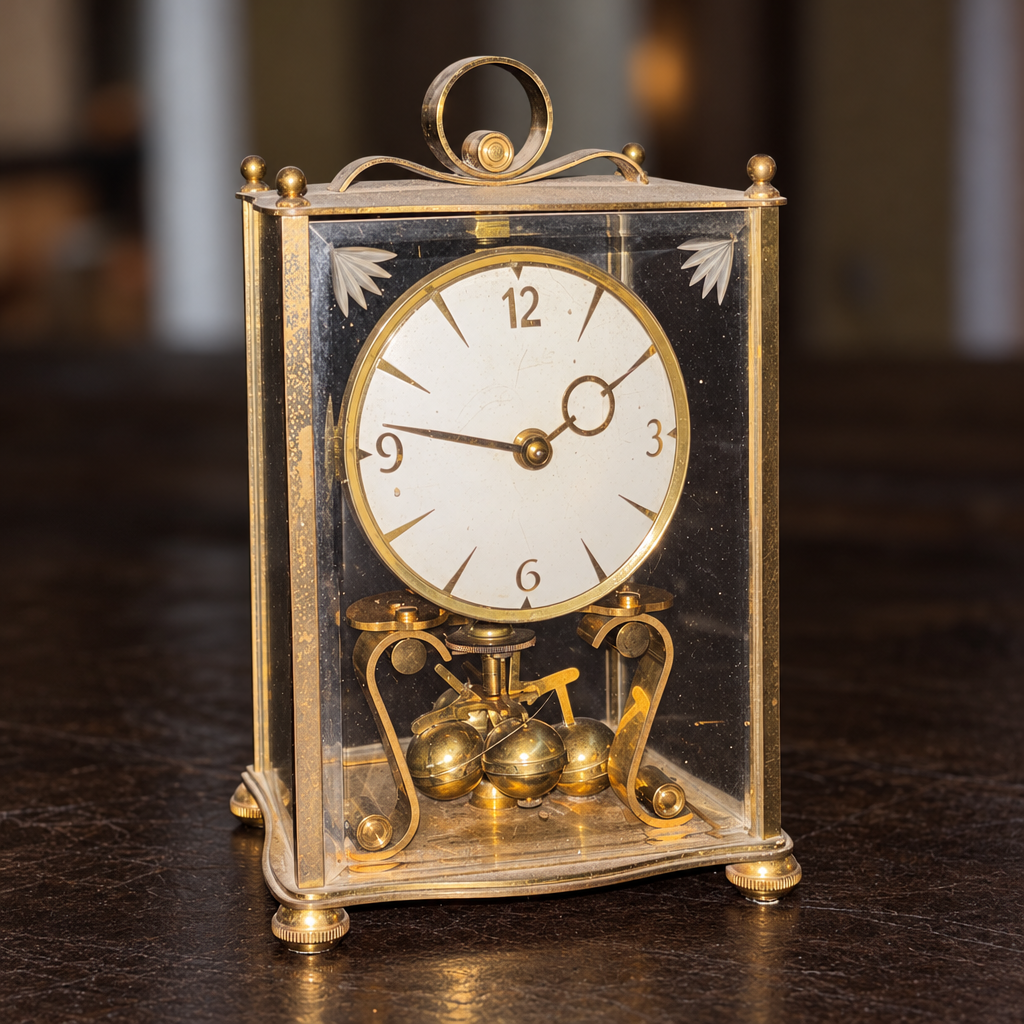
Kundo 400-Day Clock
A brass Black Forest clock that runs over a year on one winding, and how to spot one.
The short answer
This is a Kundo 400-day clock, a torsion pendulum clock made by Kieninger & Obergfell of St. Georgen in Germany's Black Forest. The firm made its first 400-day clocks in 1923 and built mechanical ones again from 1947 to about 1981, most of them in the 1950s and 1960s. Wound once, it is designed to run about 400 days.
Item Details
- Type
- Torsion pendulum clock
- Category
- Clocks
- Designer
- Unattributed factory design
- Maker / Manufacturer
- Kieninger & Obergfell
- Model / Series
- Kundo 400-Day
- Date Range
- 1950s–1960s
- Style
- Mid-century torsion clock
- Region of Origin
- West Germany
- Materials
- brass, glass
What we spotted
 1234
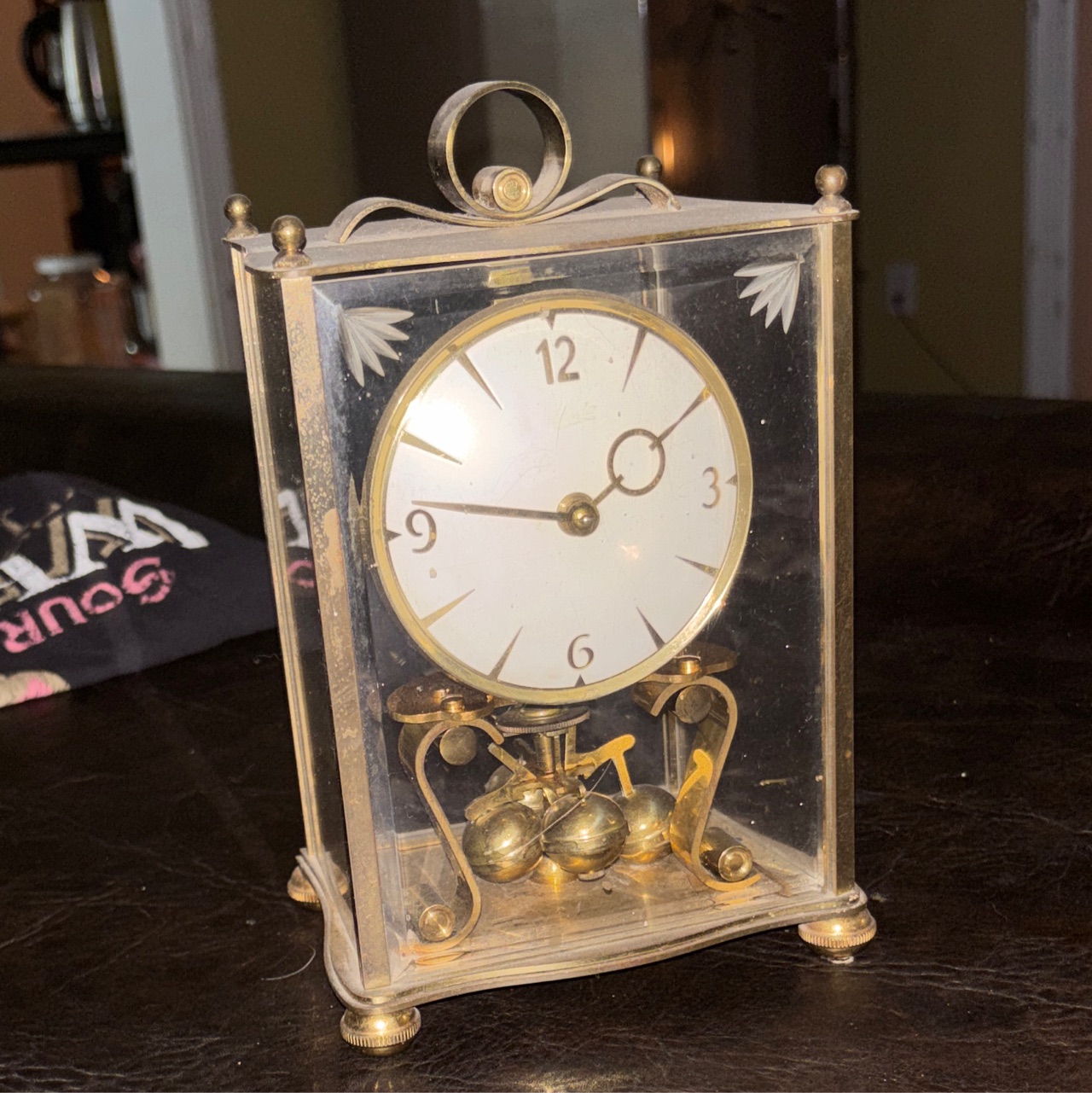
Found by a Tocuro user. Their original photo.
A case with glass walls, not the usual dome. Flat glass panels sit in a brass frame topped by a looped scroll handle.
Etched fans. Frosted leaf-like fans are cut into the two upper corners of the front glass.
A ring-tipped hour hand. The hour hand ends in an open circle, here pointing between 1 and 2 on a dial with only four numerals.
Three brass balls. The pendulum, turning slowly back and forth beneath the dial between gilt S-scroll supports.
What is the Kundo 400-day clock?
The firm began in 1899 as Johann Obergfell's clock-parts shop in St. Georgen, where he is credited with inventing the straight rod gong. George Kieninger became his partner in 1918, and the 400-day clocks followed five years later.
War halted production from about 1940 to 1947. Afterwards Kundo sold widely in North America: a brochure from about 1952 shows four standard models and three miniatures and lists service centers in the USA and Canada.
Why is it special?
- A new spring made it keep time. Torsion clocks sold well but kept poor time until 1951. That year Charles Terwilliger of the Horolovar Co. invented a temperature-compensating suspension spring. Post-war Kundos therefore arrived just as fairly accurate 400-day clocks became possible.
- Kundo kept the pendulum centred. In 1933 the firm introduced a patented guide cup in the base that stops the turning pendulum from wandering off centre. Later instruction sheets also showed how to lock the pendulum for transport, which early manuals did not cover.
How to tell a mechanical Kundo from the quartz version
| Check | Mechanical, 1947–c.1981 | Quartz, c.1981 on |
|---|---|---|
| Power | Key-wound | Battery |
| Pendulum | Pendulum twists on its spring and runs the clock | Decorative, pushed by a single finger |
| Up close | KO-in-circle logo on the movement | Fast quartz ticking |
See this find on TocuroItem details and market snapshotQuestions people ask
What does Kundo mean?
Kundo is the trademark of Kieninger & Obergfell. The wordmark appears in ads from 1952, although the firm was only officially registered as KUNDO in 1956.
Why is it called an anniversary clock?
The name suggests winding it once a year on a meaningful date. In practice it may need winding after anywhere from nine to 13 months.
How do you date a Kundo clock?
Kundos usually carry no model number, so collectors match the back plate to drawings in the Horolovar guide by Terwilliger, the man behind the 1951 spring.
Is Kundo the same company as Kieninger clocks?
No. Kieninger of Aldingen was founded separately by Joseph Kieninger in 1912 and later owned by Howard Miller. Kundo grew out of Obergfell's St. Georgen firm.
Sources
- Book: Horolovar 400 Day Clock Repair Guide, 10th Edition, Errors and Updates — NAWCC Wiki, 2025
- Kundo Jahresuhr: Lohnt sich eine Überholung? — Uhrenwerkstattforum, 2018
- Torsion pendulum clock — Wikipedia, 2025
- Help with 400 day clock identification (age) — NAWCC Message Board, 2014
- Kundo 400 Day Clock Advertising Brochure and Instructions, ca. 1952 — ClockInfo.com, 2024
- Kundo Quartz 400 Day Clock — NAWCC Message Board, 2012
- Kundo Clock Identification — NAWCC Message Board, 2024
- Instructions For A Kundo Anniversary 400 Day Clock — Hunker, 2018
By Tocuro Editors · Research checked 2026-11-08 · 3 min read
What's on your shelf?
Got a clock like this on the mantel? Snap it with Tocuro and find out who made it and when.
IDENTIFY YOUR OWN