EPIAG Peacock Covered Vegetable Dish
A peacock-decorated lidded dish from Bohemia's porcelain country, and how the mark underneath tells its era.
The short answer
It is a covered vegetable dish in EPIAG's peacock and multicolor floral pattern, made by a group of Bohemian porcelain factories around Karlovy Vary, Czechoslovakia. The EPIAG name was used from 1920 until the group was nationalised in 1945. Johann Wolfgang von Goethe visited one of those factories, at Dalovice, six times.
Item Details
- Type
- Covered vegetable dish
- Category
- Tableware & Dinnerware
- Designer
- Unattributed factory pattern
- Maker / Manufacturer
- Epiag
- Model / Series
- Pattern 6636-6656
- Date Range
- c. 1920–1958
- Style
- Bohemian floral with peacock
- Region of Origin
- Czechoslovakia
- Materials
- Porcelain
What we spotted
 1234
Found by a Tocuro user. Their original photo.
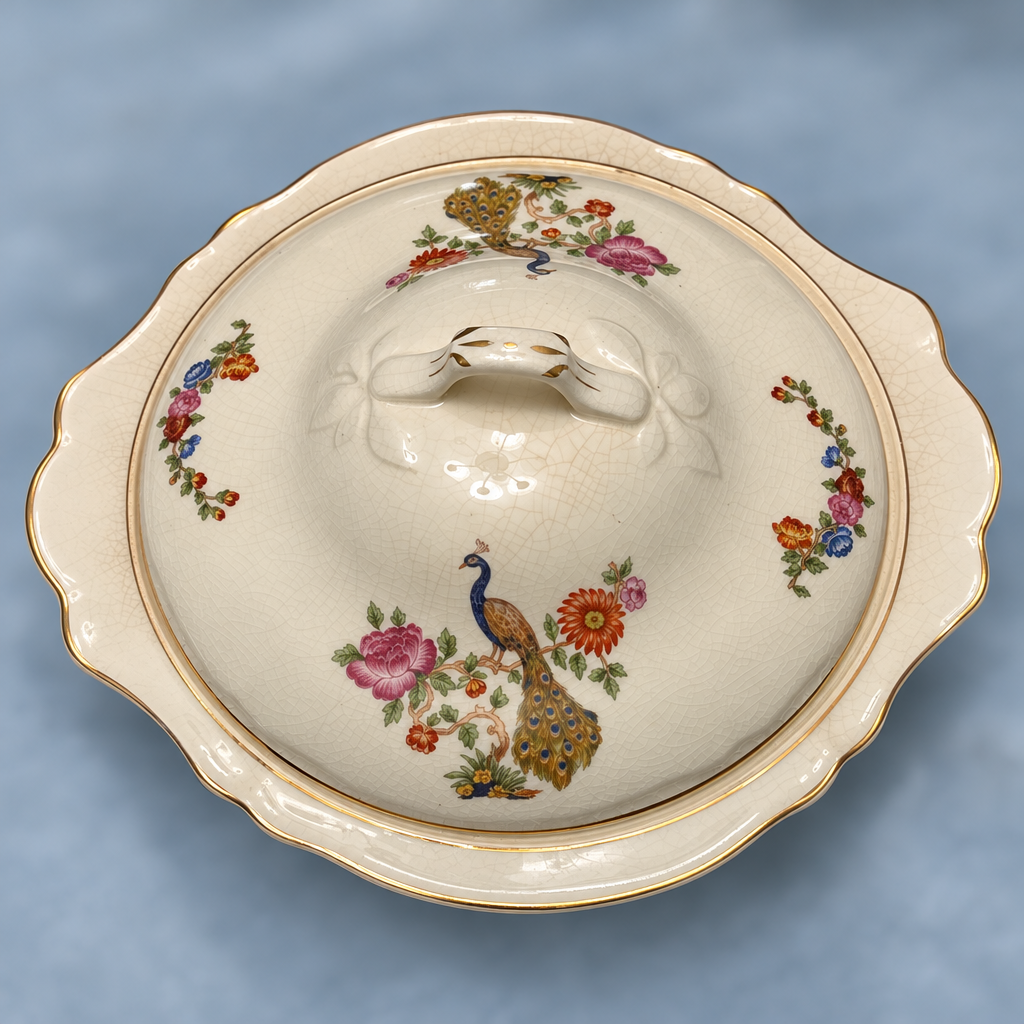
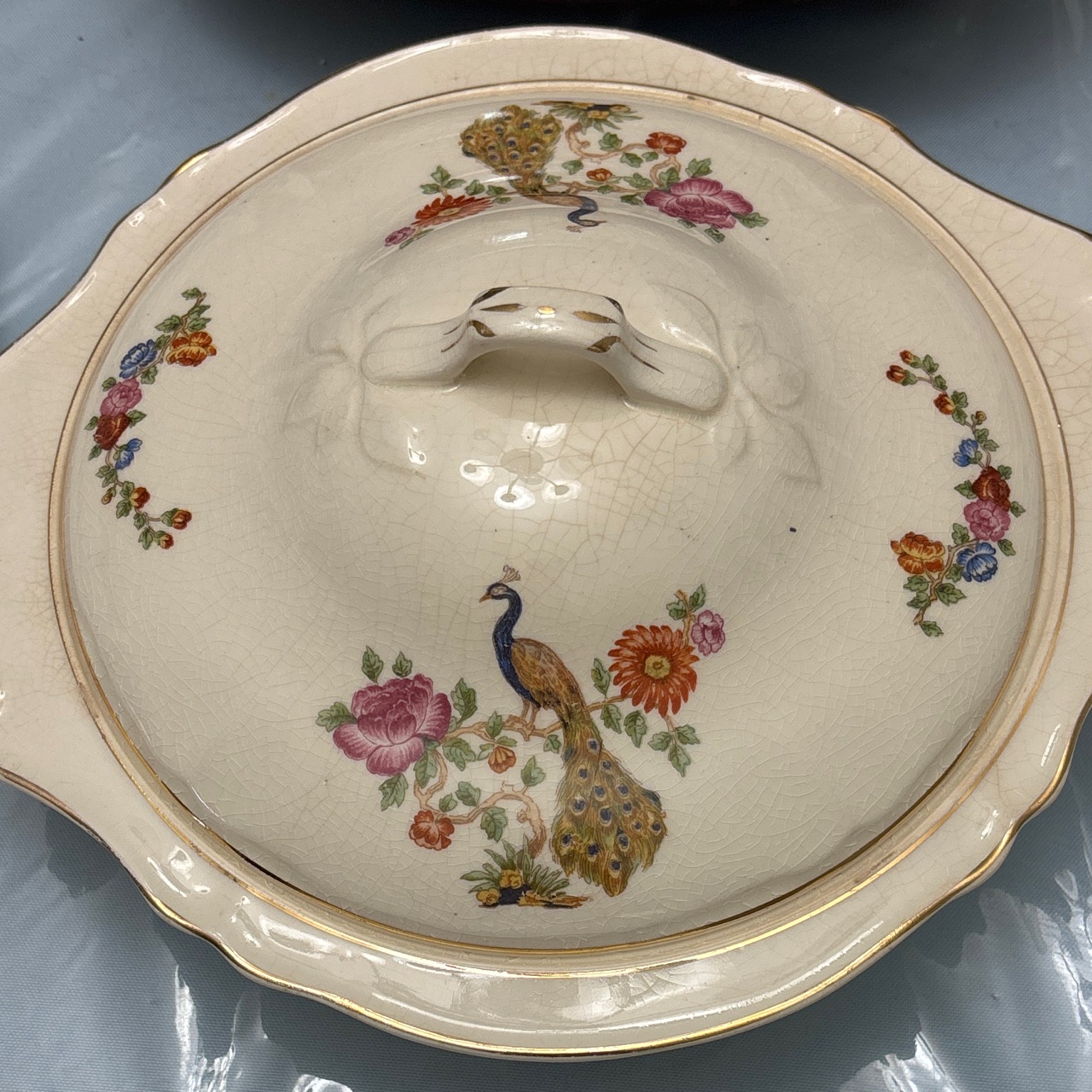
The front peacock. A blue-necked peacock perches on a flowering branch between a large pink bloom and an orange daisy-like flower.
A second bird behind the handle, this one with its tail fanned, so the lid shows a peacock to diners on either side of the table.
Crackled glaze. A fine web of crazing runs across the lid and rim, while gold still outlines the loop handle and both edges.
Round, not oval. Replacements lists an oval version, 9 1/2 in long; sellers list this round one with handles at 8 in.
What is the EPIAG peacock covered vegetable dish?
EPIAG stands for Erste Böhmische Porzellan-Industrie AG. The Austrian government formed the group in 1918 as OEPIAG to promote Bohemian porcelain sales, and it took the EPIAG name in 1920.
The dish belonged to a full dinner service in pattern 6636-6656, with plates, soup bowls, a creamer, a sugar bowl and platters up to 17 in. Sellers often call it 'Royal Peacock Flowers' or 'Peacock Garden', but neither is a factory name.
Why is it special?
- The backstamp tracks shifting borders. EPIAG marks usually read 'Czechoslovakia', but around 1940, under German occupation, some Dallwitz marks said 'Deutschland' instead. After nationalisation in 1945, Royal Epiag marks ran until 1958. The mark underneath dates a piece like this, not the decoration.
- The name outlived the company. The Dalovice factory, a pottery from 1804 and making porcelain since 1830, closed in 1997 and reopened in 2002 as EPIAG LOFIDA. It is the only maker still using the historic EPIAG trademark, so a dish marked 'Czechoslovakia' belongs to the older chapter.
How to tell a prewar EPIAG mark from a postwar one
| Check | EPIAG, 1920–1945 | Postwar, 1945 on |
|---|---|---|
| Name on mark | EPIAG with a factory mark, such as D.F. | 'Royal Epiag', used 1945–1958 |
| Extra wording | Usually just 'Czechoslovakia' | 'Porcelaine Fine de Boheme', 'Carlsbad', '1804' |
| Country | 'Deutschland' or 'Germany' around 1940 | 'Czech Republic' on LOFIDA pieces from 2002 |
See this find on TocuroItem details and market snapshotQuestions people ask
What does EPIAG stand for?
Erste Böhmische Porzellan-Industrie AG, or First Bohemian Porcelain Industry. Its earlier name, OEPIAG, began with Österreichische, meaning Austrian.
What is the Epiag peacock pattern called?
Replacements, Ltd. catalogues it as pattern 6636-6656, 'Peacock & Multicolor Floral, Gold Trim', under the code EPI6636. The pattern is discontinued.
What does D.F. mean on an Epiag mark?
It identifies the Dallwitz factory, now Dalovice. Its marks show a script 'EPIAG' above 'D.F.', often with 'Czechoslovakia', occasionally with none.
Where was Epiag porcelain made?
In factories around Karlovy Vary, then Carlsbad: Dalovice, Loket, Stará Role and Březová. Each factory kept its own mark and added the EPIAG name.
How old is Epiag porcelain?
Most pieces marked EPIAG date from 1920 to 1945. Marks reading 'OEPIAG' are earlier, from 1918 to 1920, and often use the early country name 'Čecho-Slov.'
Sources
- Epiag, 6636-6656 (pattern page) — Replacements, Ltd., 2026
- 6636-6656 Oval Covered Vegetable by Epiag — Replacements, Ltd., 2026
- Czech Epiag (marketplace listings) — Etsy, 2026
- Epiag (Erste Böhmische Porzellanindustrie A.G.), Czechoslowakia — MAK – Museum of Applied Arts, Vienna, 2024
- Related / Bohemia / Dallwitz (Dalovice) — Porcelain Marks & More, 2024
- Who's OEPIAG and EPIAG? — Value This Now, 2015
- EPIAG Dalovice — Karlovy Vary Region tourist portal, 2015
- Porcelain and pottery marks - Victoria marks — TheOldStuff, 2023
By Tocuro Editors · Research checked 2026-10-25 · 3 min read
What's on your shelf?
Got a peacock dish like this? Snap the lid and the backstamp with Tocuro to uncover its pattern and its story.
IDENTIFY YOUR OWN