
What Style Is My Furniture? A Photo-Based Guide to Naming Your Pieces
A practical guide to identifying furniture styles from photos, covering the visual details that matter most, common classification mix-ups, and how photo identification tools can help you name your pieces accurately.

What You're Actually Trying to Name
When you ask "what style is my furniture," you're usually looking at a piece that feels distinctive but doesn't come with a handy label. Maybe it's an inherited dresser with unusual hardware, a yard sale chair with carved details, or a credenza with clean lines that looks either mid-century or just old.
What you're really trying to do is match what you see—the shape, the materials, the decorative elements—to a recognized design vocabulary. Furniture styles aren't arbitrary. They're visual languages tied to periods, regions, and manufacturing methods. Once you can name the style, you can research value, find similar pieces, and understand what you actually own.
The challenge is that most furniture doesn't announce itself. A piece might blend Victorian proportions with Arts and Crafts joinery. A reproduction might mimic Georgian details but use modern shortcuts. And plenty of well-made furniture doesn't fit neatly into any textbook category at all.
Visual Classification Checklist for Furniture Style
Photos are your best tool for style classification because they force you to look at the actual visual evidence. Here's what to focus on when you're trying to determine what style is my furniture:
Overall silhouette and proportion: Step back and look at the basic shape. Is it tall and narrow (often Victorian or Chippendale)? Low and long (possibly mid-century modern)? Heavy and geometric (maybe Arts and Crafts or Mission)? The outline alone can eliminate half the possibilities.
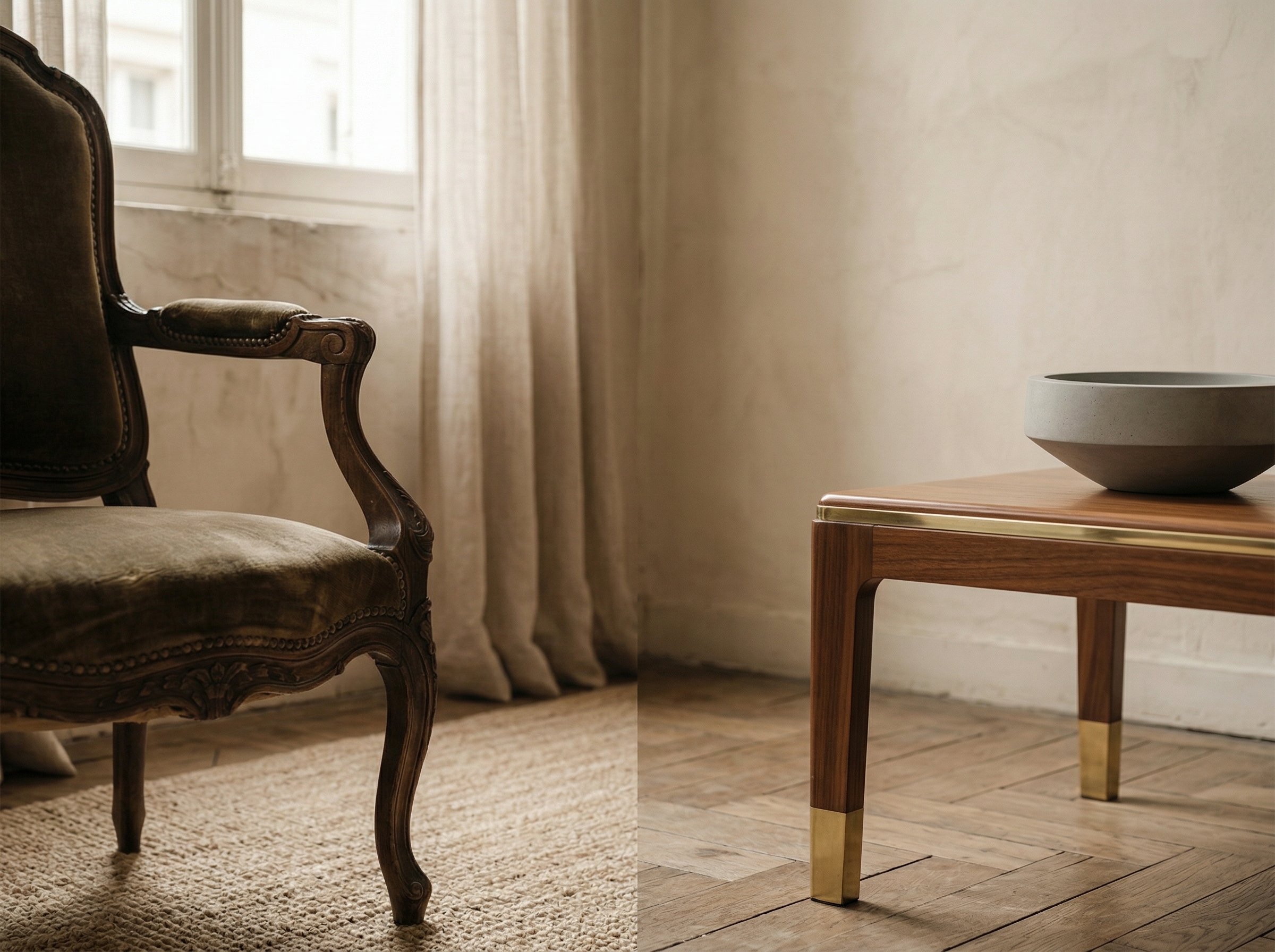
Leg style and shape: Furniture legs are surprisingly diagnostic. Cabriole legs with pad or ball-and-claw feet suggest Queen Anne or Chippendale. Tapered legs often point to Federal or Hepplewhite. Turned legs are common in Colonial and Jacobean pieces. Straight, blocky legs appear in Mission, Shaker, and mid-century designs.
Wood type and finish: Oak suggests Arts and Crafts, Mission, or earlier periods. Mahogany is common in Federal, Empire, and Georgian styles. Walnut appears in Victorian, mid-century, and some earlier American pieces. Painted finishes can indicate folk styles, Scandinavian influence, or later reproductions.
Decorative elements and ornamentation: Look for carving, inlay, veneer, or applied decoration. Heavy carving often signals Victorian, Renaissance Revival, or Baroque influence. Inlay and marquetry suggest Federal, Art Deco, or high-style European work. Minimal or absent decoration points toward Shaker, Mission, Scandinavian, or modernist styles.
Hardware and joinery: Original hardware is a huge clue. Brass pulls with bail handles suggest colonial or Federal styles. Carved wooden knobs appear on Victorian and Arts and Crafts pieces. Integrated pulls or no visible hardware are hallmarks of mid-century and contemporary design. Look at how joints are constructed—dovetails, mortise-and-tenon, pegs, or screws all tell different stories.
Construction details: Check drawer construction, back panels, and underside finish. Hand-cut dovetails suggest pre-1860s work. Machine-cut dovetails appear after that. Plywood backs point to 20th century manufacture. The level of finish on unexposed surfaces often reveals the quality tier and period.
Common Style Confusions and How to Sort Them
Some style mix-ups happen so often they're worth calling out directly.
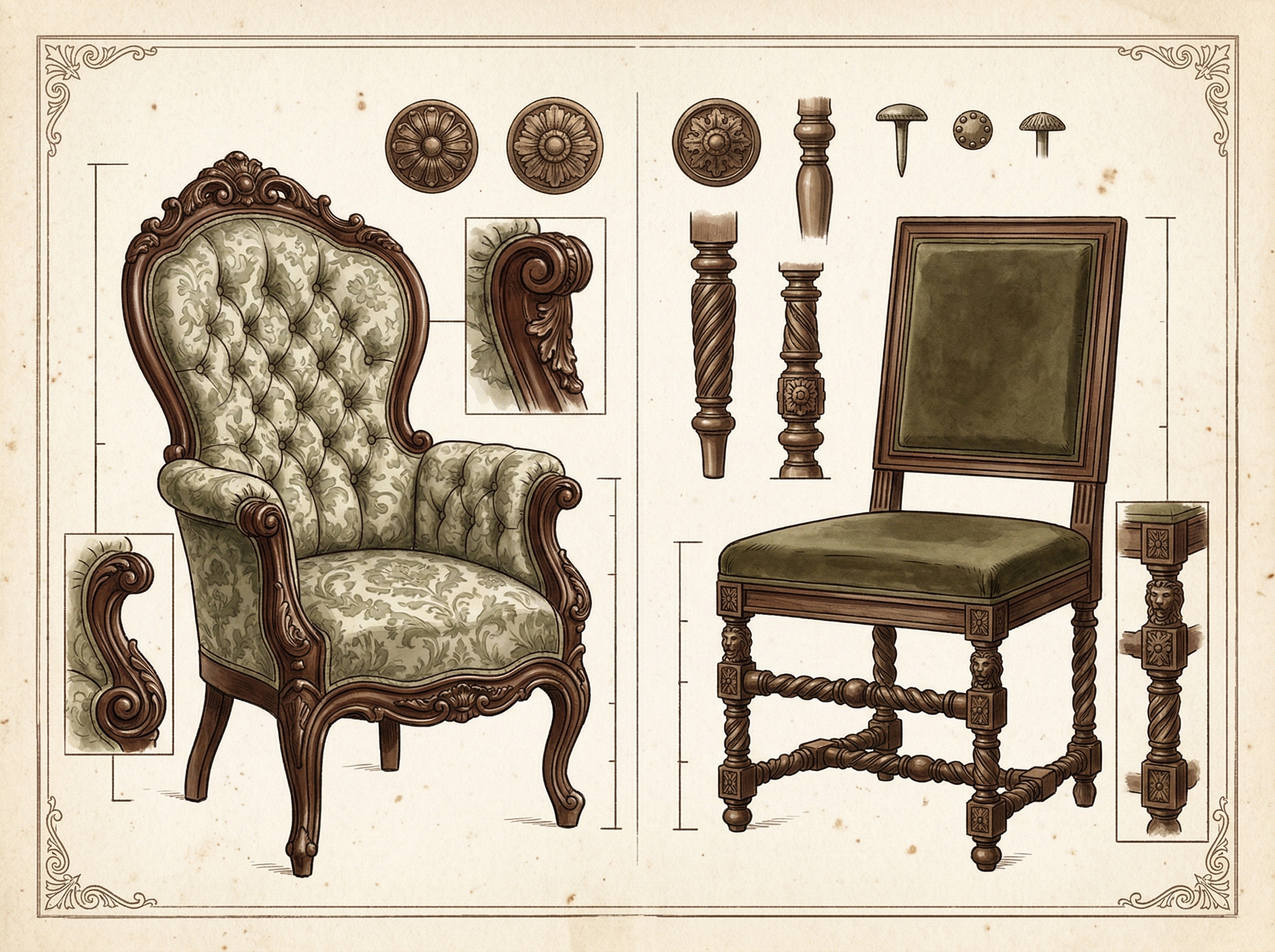
Victorian vs. Renaissance Revival
- •The confusion: Both feature heavy carving and dark wood
- •How to tell them apart: Renaissance Revival specifically references architectural motifs—columns, pediments, classical faces. Generic Victorian carving tends toward naturalistic flowers, fruits, and asymmetrical curves
Mission vs. Arts and Crafts
- •The confusion: Both emphasize visible joinery and solid oak
- •How to tell them apart: Mission (especially Stickley-style) is more severe and rectilinear. Arts and Crafts can include curved elements, decorative inlay, and softer proportions. Mission is a subset of the broader Arts and Crafts movement
Mid-Century Modern vs. Danish Modern
- •The confusion: Both are from the same era with clean lines
- •How to tell them apart: Danish Modern typically uses teak, features organic curves, and emphasizes refined craftsmanship. American mid-century modern can be more angular, uses walnut or lighter woods, and sometimes incorporates industrial materials
Federal vs. Hepplewhite vs. Sheraton
- •The confusion: All three overlap chronologically and share neoclassical roots
- •How to tell them apart: Hepplewhite favors shield-back chairs and tapered legs. Sheraton uses more rectilinear backs and often includes reeding or inlay. Federal is the broader American term that encompasses both influences plus regional variations
Reproduction vs. Period Original
- •The confusion: Good reproductions can closely mimic period construction
- •How to tell them apart: Look for tool marks, patina consistency, wood aging, and small construction shortcuts. Reproductions often have too-perfect finishes or use modern fasteners in hidden spots. This is where photos of details really help
How to Use Photo Identification to Narrow It Down
Once you've looked at the visual checklist, the next step is comparing what you see to documented examples. This is where photo-based identification tools become practical.
Tocuro lets you upload photos of your furniture and uses visual recognition to suggest style classifications based on shape, details, and construction. You get 7 free identifications per day, and the count resets daily, so you can work through multiple pieces or photograph different angles of the same item.
The advantage of photo identification isn't that it replaces your own observation—it's that it connects what you see to a broader dataset. You might notice carved details but not know whether they're Gothic Revival or Eastlake. A photo tool can surface those specific style names, then you can verify the match by comparing your piece to documented examples.
What photos work best for style classification:
- •Full frontal view showing overall proportions and symmetry
- •Close-ups of legs, feet, and joinery
- •Hardware and decorative details at high resolution
- •Side or three-quarter views that show depth and profile
- •Any labels, stamps, or maker's marks (even if unreadable to you)
The more angles you provide, the more accurately you can determine what style is my furniture. A single photo might suggest "Victorian," but additional close-ups could narrow it to Eastlake or Renaissance Revival.
Photo tools also help when you're dealing with hybrid or transitional pieces. If your furniture shows elements from multiple periods, you'll see that reflected in the suggestions, which tells you something useful: the piece might be a regional variation, a custom order, or a later interpretation.
Get Your Furniture Style Identified in Minutes
Figuring out what style is my furniture doesn't have to mean hours of flipping through reference books or posting in forums hoping someone recognizes it.
Take clear photos of your piece—front view, legs, hardware, and any decorative details—and upload them to Tocuro. You'll get style suggestions based on what's actually visible in your photos, plus context about periods and design movements. From there, you can research comparable pieces, understand value ranges, or just finally know what to call that chair.
Once you know the style, you can move forward with confidence—whether that means researching value, finding restoration resources, or just understanding what you own.
Photo identification
Identify Your Furniture
Use Tocuro to identify your item from a photo and get an estimated value range when market data is available.