
Victorian Furniture Identification: How to Spot Victorian-Era Pieces
Victorian furniture (1837-1901) features heavy proportions, dark woods like walnut and mahogany, elaborate carving, and ornate brass hardware. This guide walks you through visual identification using photos to distinguish genuine Victorian pieces from later revivals.
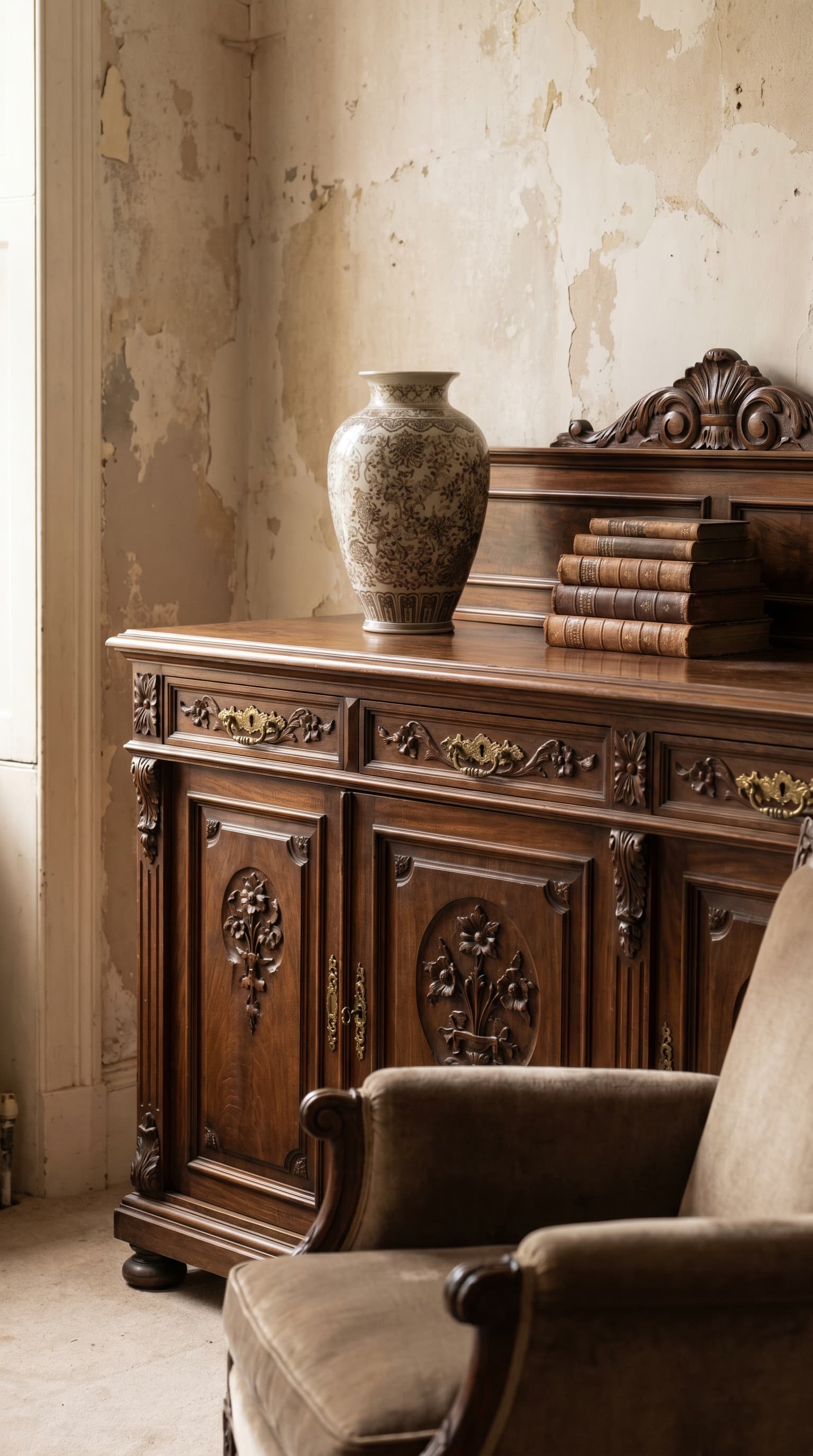
What You're Actually Looking At
When you're trying to pin down Victorian furniture identification, you're dealing with pieces made during Queen Victoria's reign (1837-1901)—a 64-year span that covers several distinct sub-styles. The term "Victorian" is an umbrella covering everything from Gothic Revival to Eastlake, but most pieces share certain telltale traits: substantial proportions, dark or richly finished woods, elaborate carving or applied decoration, and a general sense of visual weight.
Victorian furniture doesn't whisper—it announces. If your piece feels solid, heavily decorated, and a bit theatrical, you're likely looking at something from this era. The trick is distinguishing authentic Victorian work from the countless revivals produced in the 1920s, 1940s, and even today.
Visual Checklist for Victorian Furniture Identification
When examining photos of potential Victorian pieces, focus on these physical markers:
Wood and Finish
- •Dark walnut, mahogany, or rosewood (early to mid-period)
- •Golden oak (late Victorian, 1880s-1900)
- •Deep, lustrous finishes with visible grain
- •Veneers over solid construction (common and period-appropriate)
Carving and Ornamentation
- •High-relief fruit, flowers, and foliage motifs
- •Naturalistic grape clusters, roses, or oak leaves
- •Machine-assisted carving with hand-finished details
- •Applied medallions, cartouches, or decorative panels
- •Burl veneer panels as focal points
Proportions and Silhouette
- •Substantial visual weight and height
- •Curved lines—serpentine drawer fronts, cabriole legs (early Victorian)
- •Angular, geometric forms (Eastlake period, 1870s-1890s)
- •Generous seat depth and back height on upholstered pieces
Hardware and Construction Details
- •Ornate brass pulls, often teardrop or bail-style
- •Decorative escutcheons around keyholes
- •White porcelain pulls with floral transfers (cottage pieces)
- •Dovetails that are regular but not perfectly uniform (machine-cut with hand-fitting)
- •Circular saw marks on unexposed surfaces
Upholstery Evidence
- •Deep button tufting on sofas and chairs
- •Coil spring construction (introduced mid-Victorian)
- •Original frames with multiple layers of reupholstery
Common Victorian Furniture Identification Confusions
Victorian vs. Colonial Revival
Colonial Revival furniture from the 1920s-1940s mimics earlier American styles but often includes Victorian-era construction methods. The giveaway: Colonial Revival tends toward lighter woods, cleaner lines, and patriotic motifs rather than the naturalistic carving typical of true Victorian work.
Victorian vs. Edwardian
Edwardian pieces (1901-1910) immediately follow the Victorian period and can look quite similar. Edwardian furniture generally shows lighter proportions, less aggressive carving, and more delicate inlay work. The visual weight drops noticeably—Edwardian designers were reacting against Victorian excess.
Early Victorian vs. Empire
American Empire furniture (1815-1840) overlaps with early Victorian chronologically. Empire pieces emphasize bold classical forms with minimal carving, while Victorian work layers on naturalistic decoration. If it's heavily carved with flowers and fruit, lean Victorian. If it's austere with strong columns and paw feet, lean Empire.
Machine-Carved vs. Hand-Carved
Victorian furniture embraced machine carving, so finding mechanical regularity doesn't disqualify a piece. Look for hand-finished details—smoothing, undercutting, and crisp edges that required human intervention. Victorian makers used machines to rough out patterns, then refined by hand.
How to Use Photos for Victorian Furniture Identification
Photographs can reveal what you need to identify Victorian furniture, but you need the right angles and lighting.
Overall Form First
Take a straight-on photo from about six feet back. This captures proportions, silhouette, and overall decoration without distortion. Victorian pieces should show their visual weight and substantial presence in this shot.
Carving Close-Ups
Photograph decorative elements at an angle that catches shadows. Side-lighting reveals depth and hand-finishing. Look for naturalistic motifs—roses with thorns, grapes with leaves, acorns with oak leaves. Victorian carvers loved botanically recognizable subjects.
Hardware Detail Shots
Close photos of pulls, hinges, and locks help date pieces. Ornate cast brass with clear detail suggests Victorian quality work. Check for wear patterns consistent with decades of use—drawer pulls should show finger-worn spots in logical places.
Construction Evidence
If you can safely access the underside, back, or interior, photograph:
- •Dovetail joints (regular machine cutting with slight variation)
- •Saw marks on hidden surfaces (circular saw = post-1850)
- •Secondary wood species (pine, poplar, or cheaper hardwoods)
- •Springs and webbing on upholstered pieces
Maker's Marks
Photograph any labels, stamps, or markings. Victorian furniture often lacks clear attribution, but paper labels from retailers or occasionally manufacturers can appear. These help confirm date and origin when present.
For more context on reading construction details across different furniture periods, see our guide on antique furniture styles.
Sub-Styles Within the Victorian Era
Victorian isn't monolithic. Narrowing to a sub-style helps with identification:
Gothic Revival (1840s-1860s)
- •Pointed arches, trefoils, and church-inspired elements
- •Darkest woods and finishes
- •Vertical emphasis
Rococo Revival (1850s-1870s)
- •Exuberant carving with C-scrolls and S-curves
- •Cabriole legs, serpentine fronts
- •Most ornate of Victorian styles
Renaissance Revival (1860s-1880s)
- •Architectural elements: pediments, columns, pilasters
- •Burl panels and marquetry
- •Heavier, more rectilinear than Rococo
Eastlake (1870s-1890s)
- •Geometric incised carving rather than high relief
- •Turned spindles and straight lines
- •Often golden oak or lighter woods
- •Reacting against earlier Victorian excess
For help placing Victorian furniture within broader furniture timelines, check our furniture era guide.
Getting a Confident Identification
If you've photographed a piece from multiple angles and still aren't certain whether you're looking at Victorian furniture, Tocuro can help narrow it down. Upload your photos to get identification support that recognizes Victorian characteristics and distinguishes them from later revivals or adjacent periods.
Identify Your Item using Tocuro's photo-based identification tool. You'll get style classification help along with context about what your photos reveal regarding age, construction, and characteristics specific to Victorian furniture.
Understanding Victorian furniture identification gives you confidence when shopping estate sales, evaluating inheritances, or simply satisfying your curiosity about that imposing dresser in the guest room. Once you know what to look for, Victorian pieces become easier to spot—and harder to confuse with the many styles that came before and after.
Photo identification
Identify Your Furniture
Use Tocuro to identify your item from a photo and get an estimated value range when market data is available.