
Shaker Furniture Identification: How to Recognize Clean Lines and Honest Construction
Shaker furniture identification relies on recognizing radical simplicity: no ornamentation, honest joinery, gentle tapers, and carefully chosen hardwoods. This guide walks you through the visual markers that separate authentic Shaker design from Revival pieces and other plain styles.
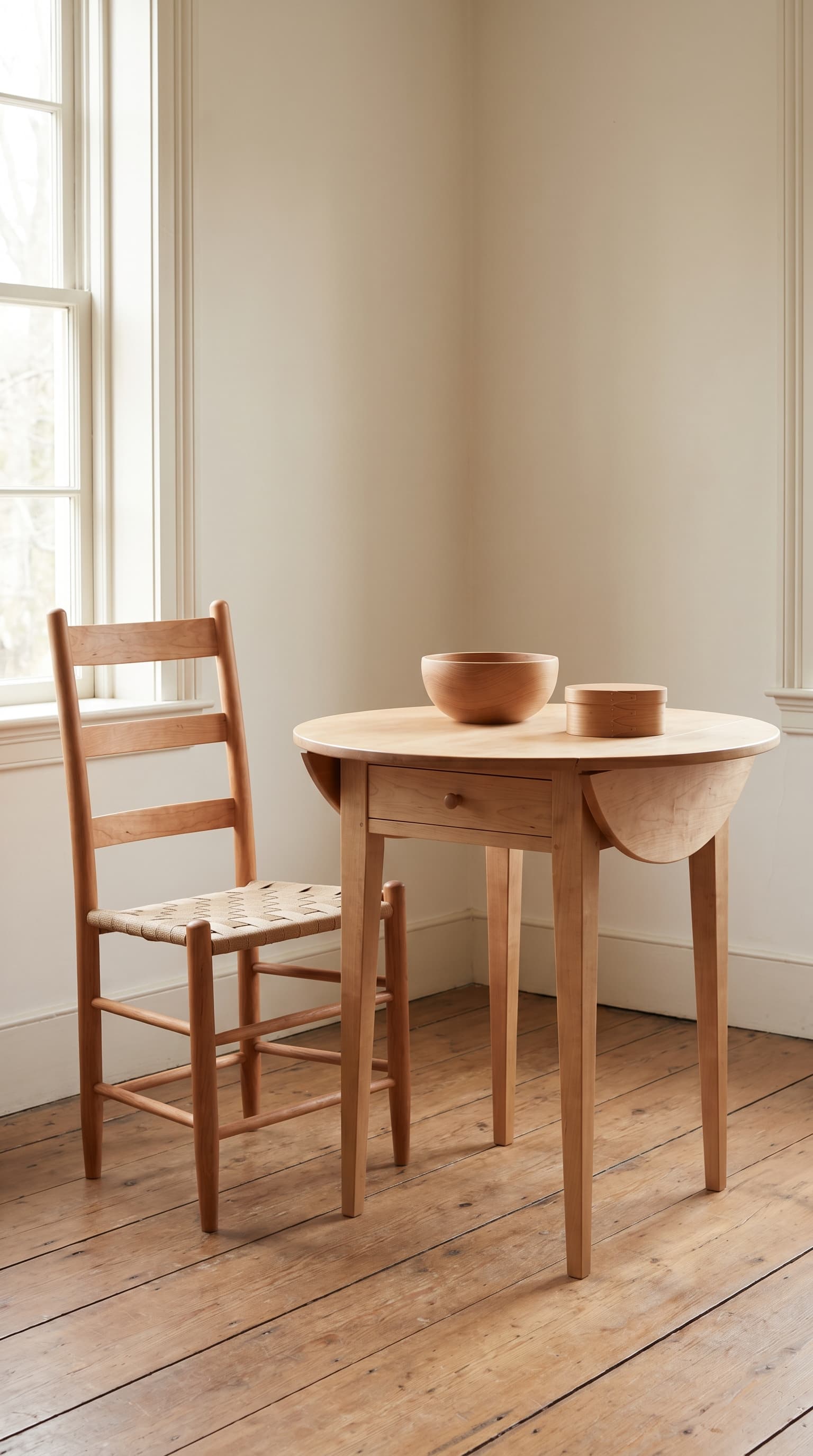
Shaker Furniture Identification: How to Recognize Clean Lines and Honest Construction
When you're looking at a simple wooden chair or table and wondering if it's Shaker, you're trying to identify one of America's most influential furniture traditions. Shaker furniture identification starts with understanding that these pieces weren't just plain—they represented a religious community's philosophy that beauty came from utility, honesty, and perfection of proportion. Made primarily between 1790 and 1900 by members of the United Society of Believers, authentic Shaker furniture shows a discipline and refinement that sets it apart from simply "plain" country pieces.
The challenge is that Shaker design's influence was so profound that countless later makers adopted similar aesthetics, and the term "Shaker style" gets applied loosely to almost any unadorned wooden furniture.
What You're Actually Looking At
Authentic Shaker furniture falls into several categories. Community-made pieces were built for use within Shaker villages—chairs for meeting houses, tables for dining halls, storage for workshops. These represent the purest expression of Shaker design principles. Production pieces, particularly chairs and oval boxes, were made for sale to "the World" (non-Shakers) and helped support the communities financially. These still follow strict design rules but were made in larger quantities.
Shaker Revival pieces appeared from the 1930s onward as collectors and designers rediscovered the style. Quality varies enormously—some are careful reproductions by skilled craftspeople who studied original examples, while others are mass-produced approximations that miss the subtlety.
Contemporary "Shaker-style" furniture describes modern pieces influenced by the aesthetic but not claiming historical authenticity. These often incorporate modern materials or construction methods.
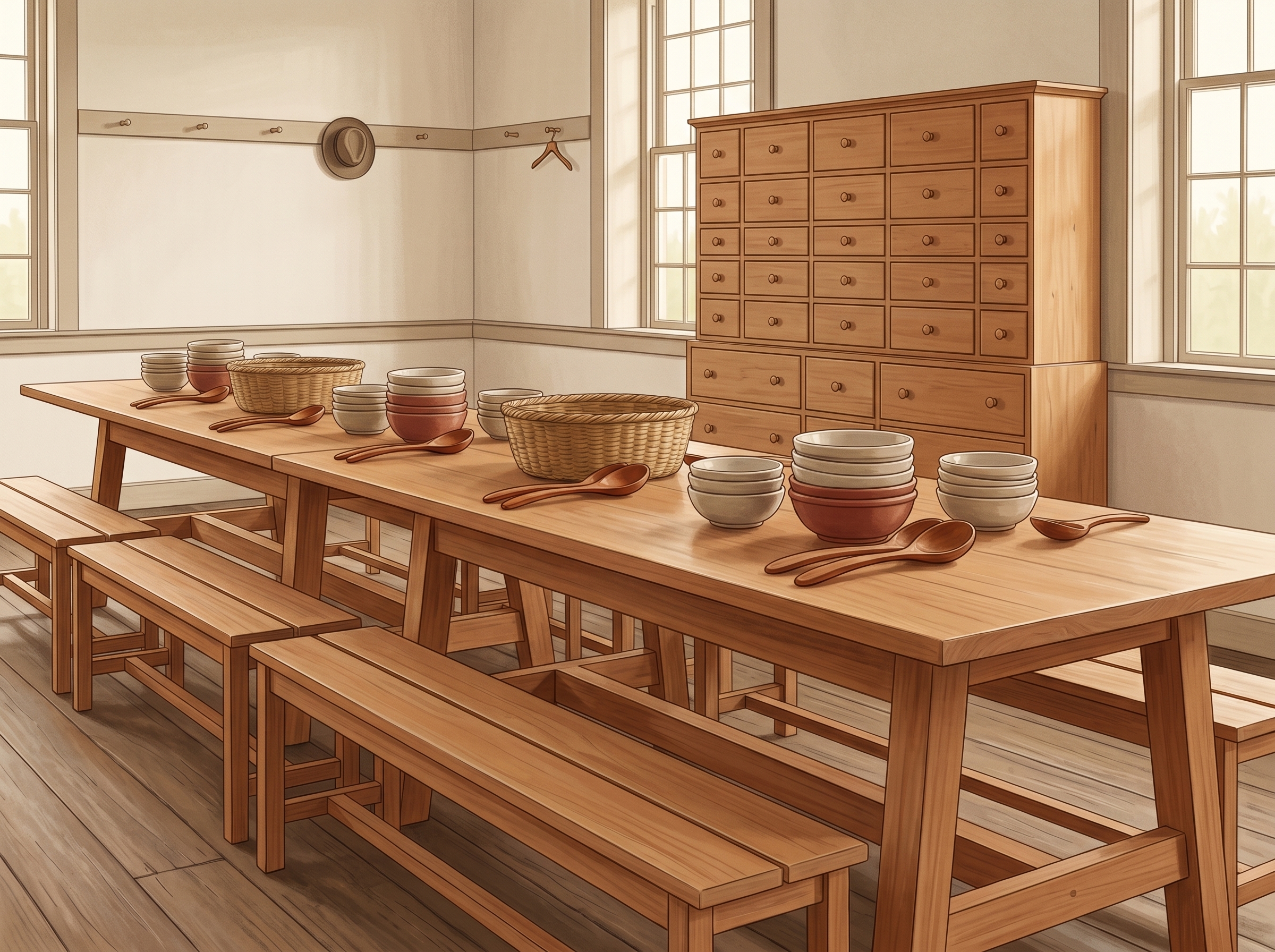
Visual Shaker Furniture Identification Checklist
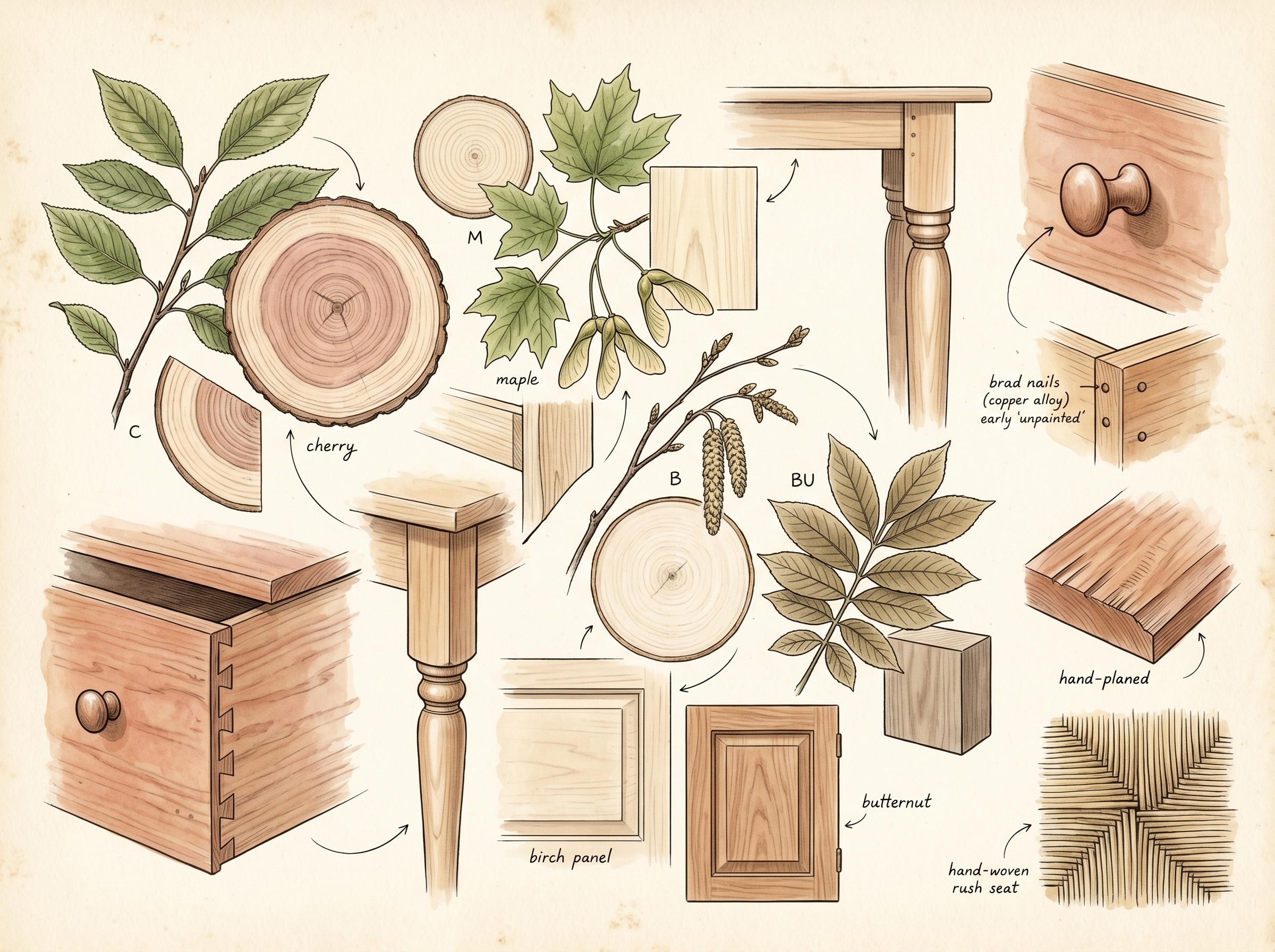
Wood selection and finish: Authentic pieces use native northeastern hardwoods—cherry, maple, birch, butternut, walnut, or pine for secondary parts. The wood is carefully selected for straight grain and minimal figure. Early pieces often show natural patina or thin wash coats; later community pieces sometimes used warm red or yellow stains. The finish is always thin and lets the wood breathe. Thick polyurethane or dark stains that obscure the grain suggest later reproduction.
Absence of ornament: This goes beyond "simple." Shaker furniture has no carving, no inlay, no turned decorations, no moldings for decoration's sake. What looks like restraint is actually intention—every element serves a function. The beauty comes from proportion and the quality of execution, not applied decoration.
Tapered legs and posts: Chair legs, table legs, and bed posts show gentle, subtle tapers that start well below the top—not dramatic turnings or abrupt transitions. The taper is so refined it's almost subliminal. It provides visual lightness without sacrificing strength.
Joinery quality: Mortise-and-tenon joints, dovetails on drawers, and pegged construction show precise, careful work. Joints fit tightly without glue showing. Drawer dovetails are hand-cut and thoughtfully proportioned—not the uniform machine-cut dovetails of later factory furniture. Look for slight variations in spacing and angle that indicate hand work.
Proportional relationships: Shaker pieces show mathematical relationships between parts—rail widths relate to leg thickness, drawer heights progress in pleasing ratios. Nothing feels arbitrary. The overall form appears balanced from every angle.
Hardware and fixtures: Turned wooden knobs, simple iron or brass catches, minimal hinges. Shaker communities made their own hardware or purchased plain commercial versions. You won't find ornate pulls, decorative escutcheons, or fancy hinges. Tilting chair buttons (wooden or leather spheres on the back posts) appear on many Shaker chairs—a practical device to protect floors and walls.
Ladder-back chair design: Shaker chairs typically show three to seven arched slats (not flat), turned front posts with minimal decoration, woven tape seats in traditional patterns, and those characteristic back post finials (acorn or flame shapes, but simplified).
Common Shaker Furniture Identification Confusions
Shaker vs. Arts and Crafts
Both emphasize honest construction and quality materials, which creates overlap. Arts and Crafts furniture (Mission style) is typically heavier, with visible through-tenons, quartersawn oak showing prominent ray flake, and exposed joinery celebrated as ornament. Shaker work is lighter, joints are concealed or minimal, and the wood grain is usually subtle. Arts and Crafts says "look at this craftsmanship," while Shaker says "use this thoughtfully made object."
Shaker vs. Country Primitive
Country furniture can look similarly plain, but it lacks Shaker refinement. Proportions may be awkward, tapers less subtle or absent entirely, surfaces less finished. Country pieces often show expedient construction—whatever worked fastest. Shaker furniture shows careful deliberation in every dimension. The difference is in the details: a Shaker chair back slat has a precise arch and consistent thickness; a country chair might have roughly shaped slats that vary.
Shaker vs. Colonial Plain Styles
Early American furniture before Shaker influence (1700s) was often plain by necessity or regional tradition. These pieces typically show construction methods appropriate to their period—different saw marks, different proportions, earlier hardware styles. Many also incorporate period-appropriate turnings or minimal decoration that Shakers avoided. Context and construction methods help separate them—learning furniture era characteristics provides the framework.
Revival and Reproduction Quality
Some mid-20th-century Shaker Revival furniture is beautifully made by craftspeople who deeply studied the originals. Others are factory-produced approximations that get the general idea but miss the proportional subtlety. Photos should capture joinery details, wood grain and finish characteristics, and overall proportions to help distinguish careful reproductions from crude copies.
How to Use Photo Identification to Narrow It Down
When photographing furniture for Shaker identification, capture what makes these pieces distinctive. Start with a well-lit full view showing overall proportions and form—this reveals whether the piece has that characteristic Shaker balance.
Detail shots of joinery: Close photos of how stretchers meet legs, how drawer fronts join sides, how table aprons attach. Shaker joinery is precise but not showy. You're looking for tight-fitting mortise-and-tenon joints, hand-cut dovetails with slight irregularities, and wooden pegs that sit flush or slightly proud.
Leg and post tapers: Photograph legs from the side where the taper is visible. The transition should be smooth and gradual, starting several inches below the seat or tabletop. Compare the thickness at top versus bottom—Shaker tapers are gentle, not dramatic.
Hardware and fixtures: Clear close-ups of any knobs, catches, hinges, or chair buttons. Original Shaker hardware is simple but well-made. Modern replacement hardware, while functional, often lacks the weight and finish of period pieces.
Wood grain and finish: Photos showing the wood surface in good natural light reveal whether the piece uses straight-grained hardwood with minimal figure and a thin finish. Over-stained pieces or those with thick, glossy finishes raise questions.
Maker's marks or labels: Some Shaker communities marked their furniture, particularly production pieces. Marks might be stamped, branded, or written. Original labels occasionally survive on drawer bottoms or chair undersides.
Underside and back views: Photos of unexposed surfaces show construction methods, wood selection for secondary surfaces, and finish patterns that help with authentication. Original pieces show consistent aging across all surfaces.
For chairs specifically, photograph the slat arch profile, the back post finial shapes, the seat weaving pattern, and any tilting chair buttons. For case pieces, capture drawer construction, interior finish, and back panel treatment.
Get Help Identifying Your Furniture
If you've got photos of furniture you think might be Shaker, Tocuro can help narrow down the style, period, and potential origins. Upload clear images showing overall form, joinery details, and any marks or labels. Identify Your Item to get specific insights based on what your photos reveal about construction methods, materials, and design characteristics. The platform uses market signals to provide context about similar pieces, helping you understand not just what you have but where it fits in the broader landscape of American furniture.
Shaker furniture identification rewards careful observation—these pieces reveal their quality through subtle refinement rather than obvious ornament. Understanding what to look for helps you recognize the real thing and appreciate the philosophy behind every carefully proportioned dimension.
Photo identification
Identify Your Furniture
Use Tocuro to identify your item from a photo and get an estimated value range when market data is available.