
Paper Money Identification: How to Identify Old Paper Money by Photo
Identifying old paper money requires attention to serial numbers, seal colors, series dates, and signature combinations. This guide shows which details matter most and how to photograph them clearly for accurate identification.
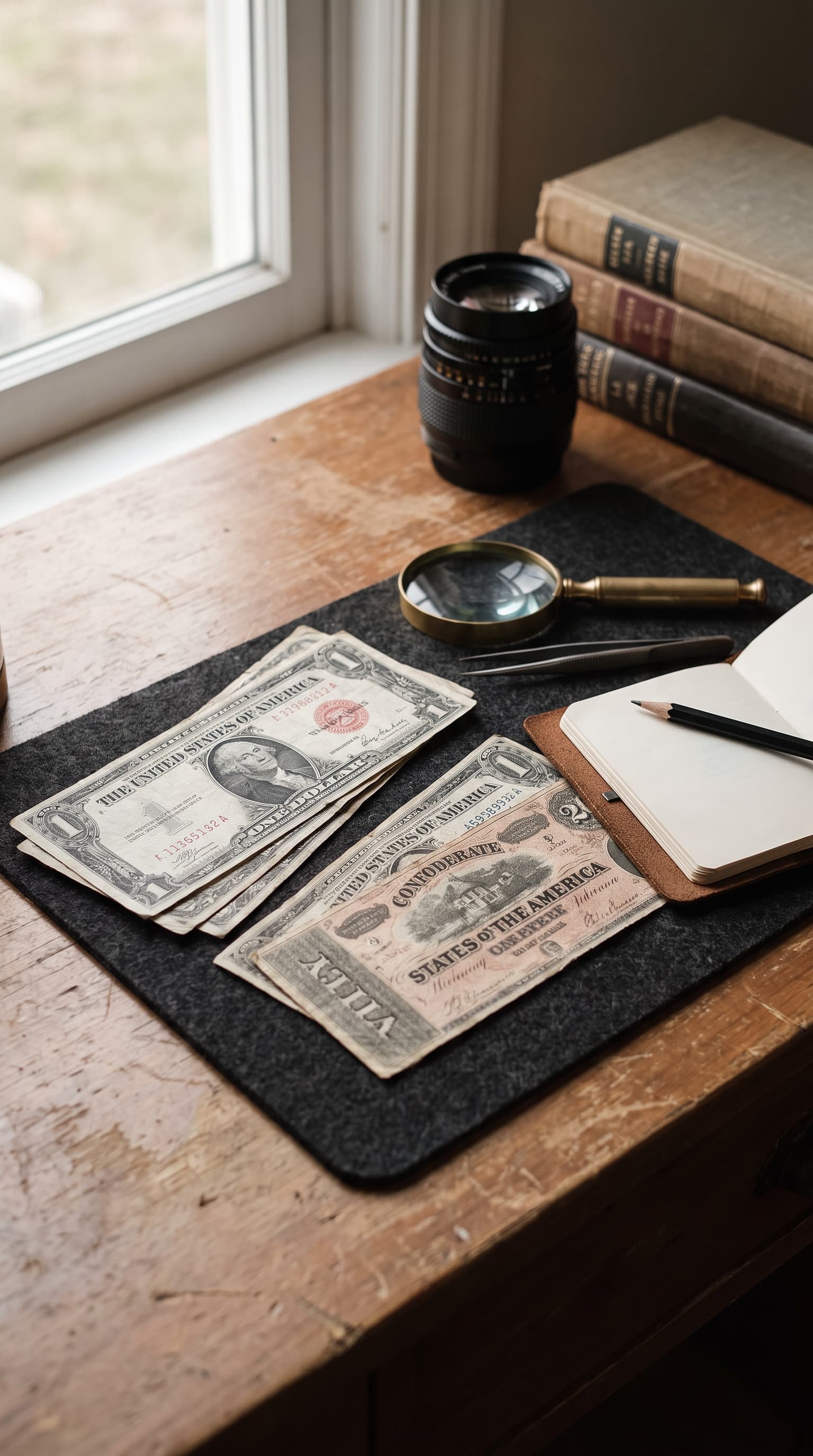
Paper Money Identification: How to Identify Old Paper Money by Photo
Identifying old paper money means reading the details printed on every note. Unlike old coins, paper currency carries explicit information about when it was printed, who authorized it, and what type of note it is. The challenge isn't finding clues—it's knowing which ones matter and how to capture them clearly in photos.
Whether you've inherited a collection, found a note in an old book, or bought a lot at an estate sale, accurate identification starts with understanding what the Treasury Department printed on the bill itself.
What Clues Matter for Paper Money Identification
Every piece of U.S. paper currency includes standardized information, but the format and location changed across decades. Here's what you need to check:
Serial numbers appear twice on most notes, usually in the upper right and lower left corners. The letter prefix and suffix reveal the district and print run. Star notes (with a star replacing the last letter) indicate replacement notes and often carry premium value. Eight-digit serials are standard, but low numbers (under 100) and special patterns (ladders, repeaters, solid digits) interest collectors.
Seal color immediately narrows the type and era. Blue seals indicate Silver Certificates. Red seals mark United States Notes or certain wartime issues. Green seals appear on Federal Reserve Notes. Brown seals identify National Bank Notes or special WWII Hawaii and North Africa issues. Gold seals are rare and appear only on pre-1933 Gold Certificates.
Series date appears near the portrait or Treasury signature. This isn't the print date—it's the year the design was authorized. A note marked "Series 1928" could have been printed any time until the next design change. Letter suffixes (1928A, 1928B) indicate minor design modifications or signature changes.
Signature combinations help pinpoint the exact printing window. The Treasurer and Secretary of the Treasury both sign currency, and their terms overlap in specific ways. Matching the pair against reference guides narrows dates significantly.
Bank district appears on Federal Reserve Notes. A letter and number (A1 for Boston, B2 for New York, etc.) identify which of twelve regional banks issued the note. Some districts are scarcer than others for specific series.
Size and condition tell you whether the note is large (pre-1929) or small (1929 onward). Large-size notes measure approximately 7.4 × 3.1 inches. Small-size notes are 6.1 × 2.6 inches, the standard still used today. Condition affects value dramatically—creases, stains, and tears all matter.
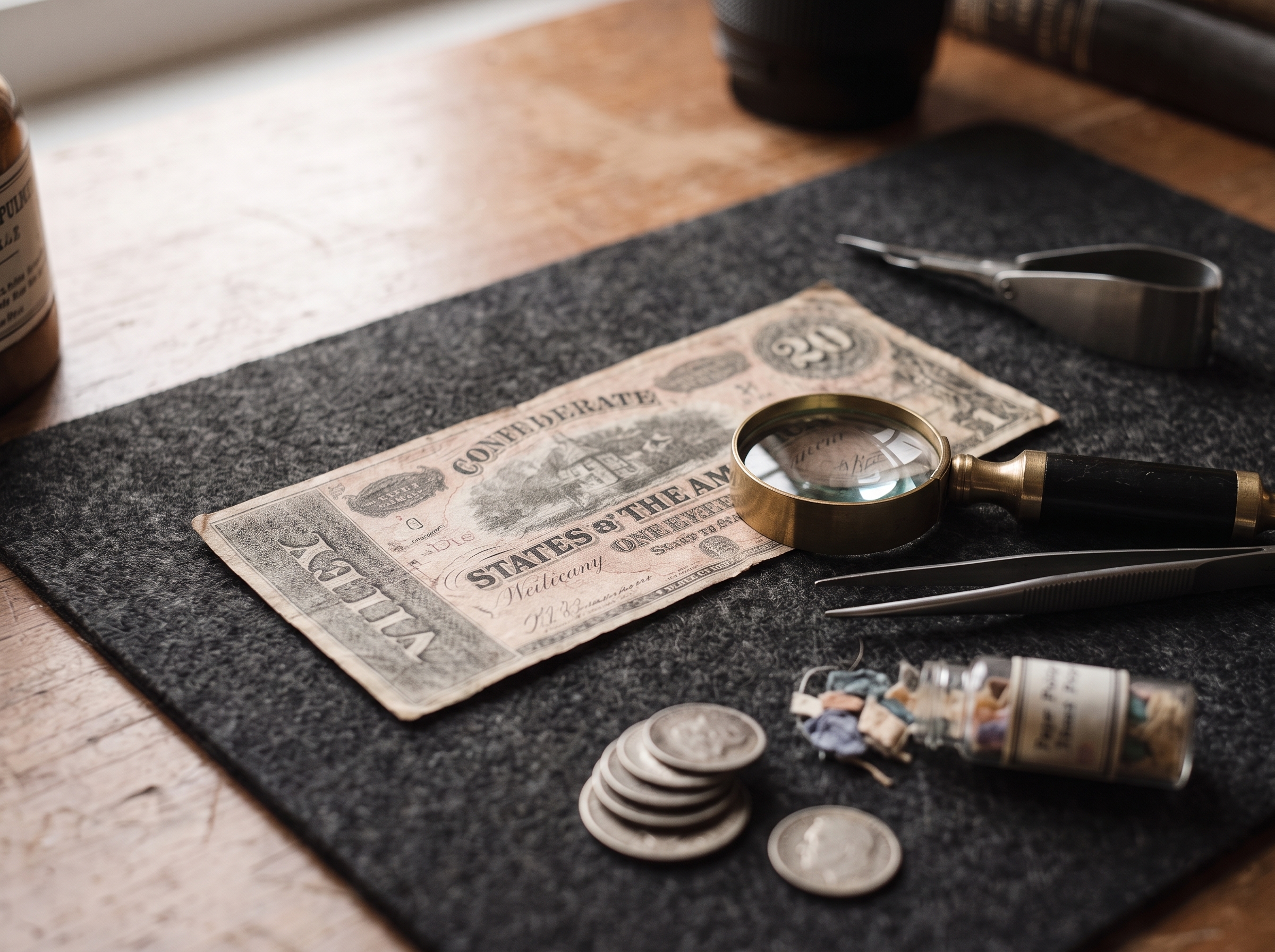
What Photos to Take for Paper Money Identification
Good identification photos require even lighting and sharp focus. Currency details are small, and blurry images miss critical information.
Full front and back shots at high resolution capture the overall design, denomination, and layout. Lay the note flat on a neutral surface without shadows. Natural indirect light works better than flash, which creates glare.
Close-up of the serial number on both corners confirms the full sequence and any star designation. Tilt the note slightly if embossing or ink texture doesn't show clearly.
Seal and series date detail requires a separate close-up. The seal color must be accurate—poor lighting can make red look brown or blue look green. Include the series date and any letter suffix in the same frame.
Signature area needs clear focus to read both names. If the signatures are faint or the note is worn, use angled light to bring out the engraved lines.
Any unusual features deserve their own photo. Overprints (like "HAWAII" on WWII notes), misaligned printing, or paper flaws can significantly affect value and identification. If the note has a watermark or security thread (on modern issues), capture that too.
Edge and corner condition photos help assess grade. Collectors want to see whether edges are crisp, corners are sharp, and margins are intact.
Avoid using filters or editing apps that change color. Accurate identification depends on seeing the note as it actually appears.
Common Misidentifications in Paper Money Identification
Certain assumptions trip up even experienced collectors when they rely on incomplete information.
Assuming age from condition: Worn doesn't always mean old. Federal Reserve Notes from the 1960s circulated heavily and often look worse than carefully stored large-size notes from the 1920s. Check the series date and design, not just the wear.
Confusing series date with print date: A Series 1935 Silver Certificate could have been printed in 1935, 1940, or 1955, depending on the letter suffix. The series date marks the design authorization, not the actual printing year.
Misjudging seal color under poor lighting: Red and brown seals can look similar in dim or warm light. Blue and green can appear interchangeable in some photos. Always photograph under neutral daylight or use a reference chart to confirm hue.
Overvaluing common star notes: Star notes are replacements, not errors. While they're scarcer than regular serials, many star notes from common series are worth only modest premiums. Rarity depends on the specific series, district, and print run size.
Ignoring the note type: A $1 Silver Certificate and a $1 Federal Reserve Note from the same era look similar at a glance, but they're different instruments with different market values. The seal color and text below the portrait identify the type.
Expecting high value from 1928–1950s small notes: Millions of small-size notes from this window survive. Unless you have a rare district, star serial, or pristine condition, most common issues trade near face value or just above.
What Tocuro Can Help Resolve
Paper money identification involves cross-referencing dozens of variables. Tocuro simplifies the process by analyzing the photos you take and matching them against market data.
Upload clear images of your note's front, back, serial, and seal. Tocuro identifies the series, type, and district, then provides an estimated value range based on current market signals. This isn't a formal appraisal, but it gives you a practical sense of what similar notes are trading for.
If you're sorting an inherited collection or deciding whether a note is worth professional grading, Tocuro helps you prioritize. You get 7 free identifications per day, and the count resets daily—enough to work through a shoebox of currency without rushing.
The platform recognizes subtle differences: star notes vs. regular serials, rare district combinations, and signature pairs that signal short print runs. It also flags condition issues that affect value, so you know whether a note is worth protecting or just spending.
Ready to Identify Your Paper Money?
Whether you're holding a Silver Certificate from the 1930s or a Federal Reserve Note with an interesting serial, accurate identification starts with the right photos. Tocuro turns those images into actionable information—series, type, district, and value range—so you can make informed decisions about your collection.
Identify your paper money now and see what you're holding in minutes.
Photo identification
Identify Your Coin
Use Tocuro to identify your item from a photo and get an estimated value range when market data is available.