
Lamp Maker Marks: How to Read Socket Labels and Base Stamps
Lamp maker marks appear on sockets, bases, shade hardware, and internal components. Understanding where to look and what these marks can tell you helps identify manufacturers and estimate age, though many lamps lack any identifying marks at all.
Lamp Maker Marks: How to Read Socket Labels and Base Stamps
Lamp maker marks hide in surprising places—stamped into brass sockets, embossed on weighted bases, printed on internal labels, and cast into decorative elements. Unlike pottery marks or porcelain backstamps, lamp marks often appear across multiple components, and reading them requires knowing where manufacturers typically placed their identifiers. This guide shows you exactly where to look and what those lamp maker marks can reveal about your piece.
Where to Find Lamp Maker Marks
Manufacturers marked different lamp components depending on the era and production method. Check these locations systematically:
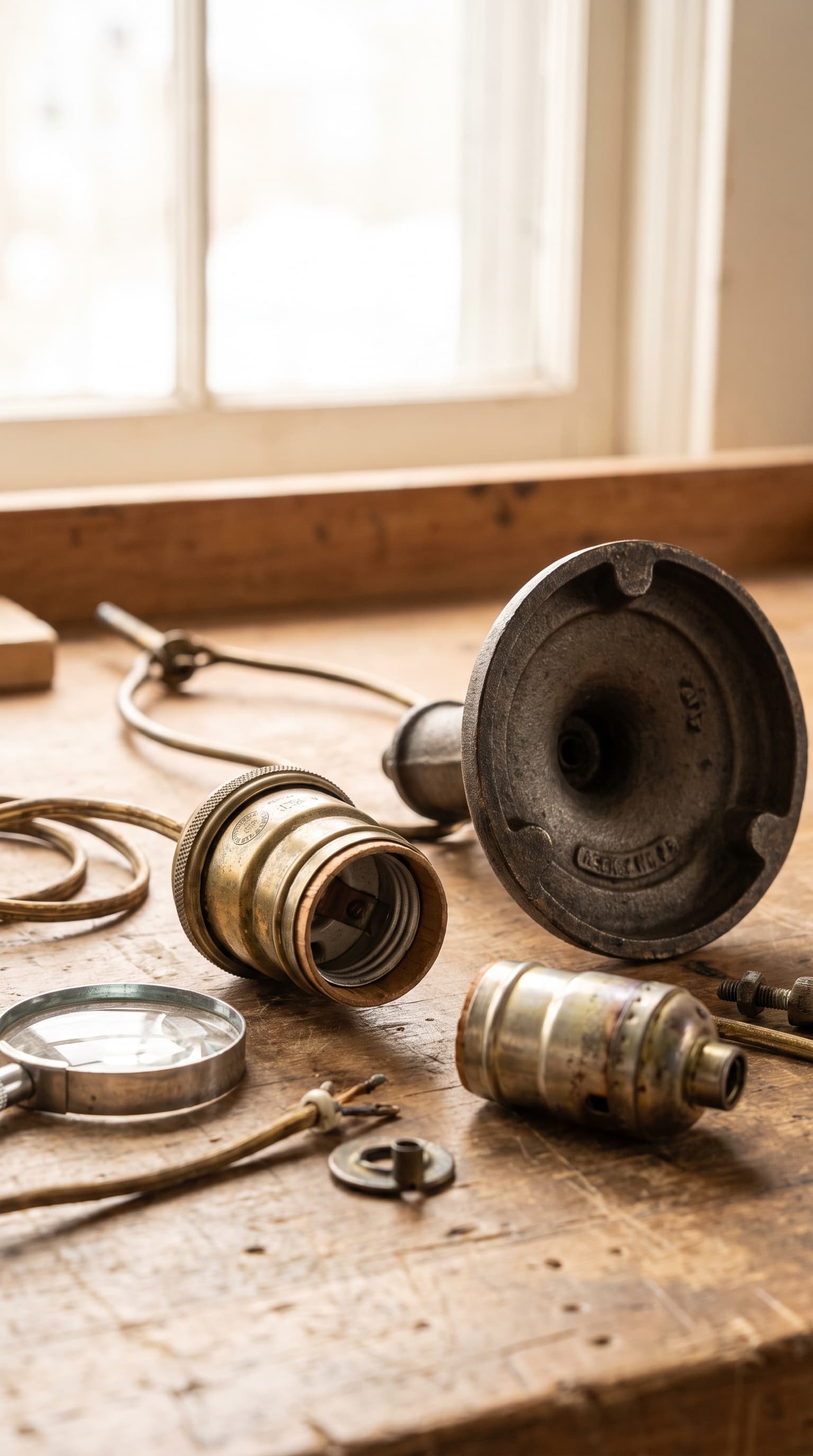
Socket housings show the most consistent marking. Turn the lamp upside down and examine the threaded brass or metal socket shell. Many sockets carry maker names, model numbers, or patent dates stamped directly into the metal. Look for names like "BRYANT," "PERKINS," "LEVITON," or "HUBBELL" circling the base of the socket where it screws into the lamp body.
Weighted bases on table lamps often include manufacturer information. Metal bases may have embossed or stamped marks on the bottom felt pad. Peel back or examine the edges of felt carefully—marks often appear near the cord exit hole. Cast iron or pot metal bases sometimes show raised lettering or model numbers molded into the metal itself.
Shade hardware and fitters occasionally carry marks, especially on quality pieces. The metal ring that holds the shade (the fitter) may show maker stamps. Spider fittings, slip fitters, and harp hardware sometimes include manufacturer codes or patent information.
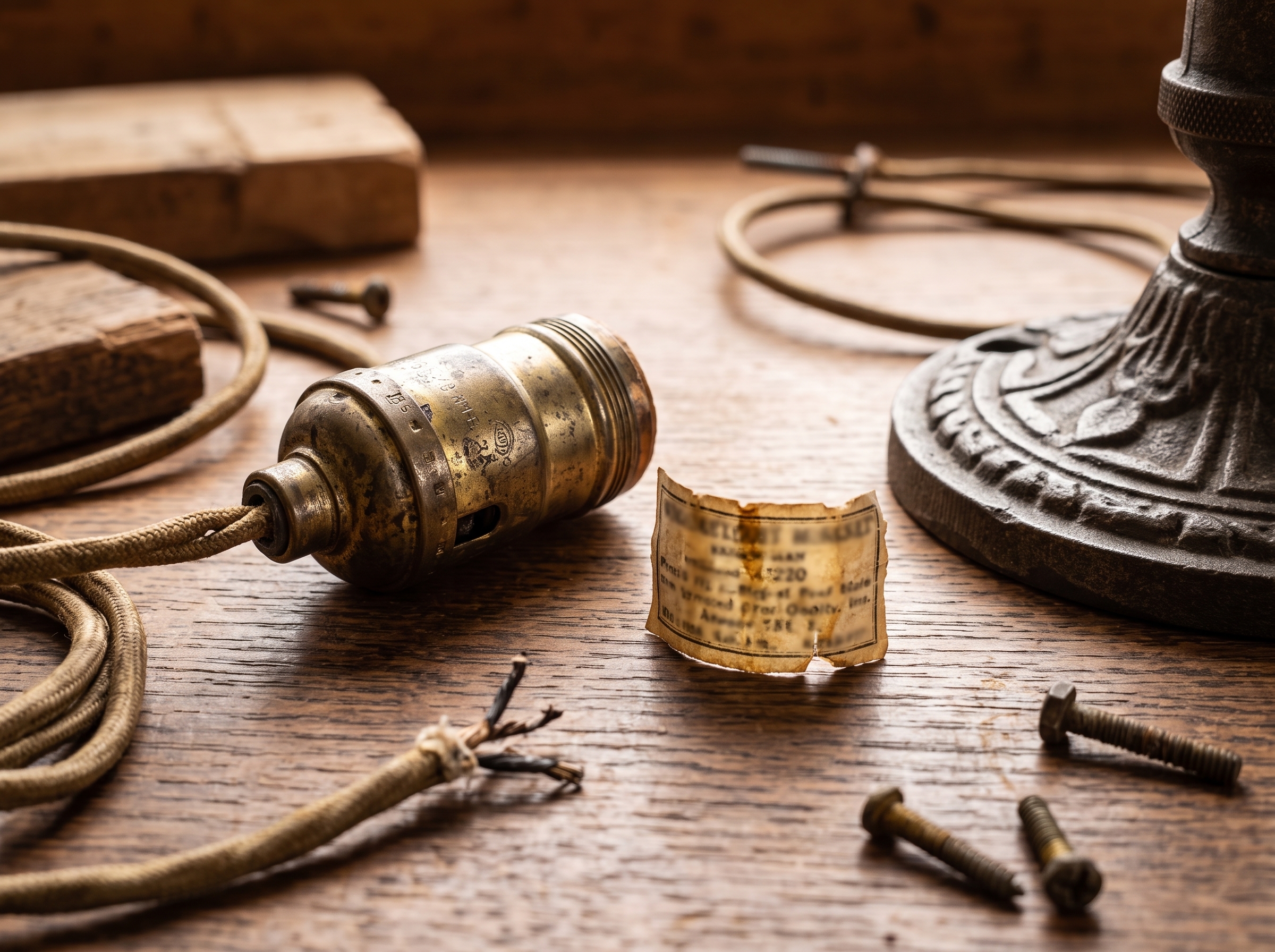
Internal labels survive on many mid-century and later lamps. These paper or foil stickers attach to the inside of the socket housing or the underside of the base. They deteriorate with heat and age, so handle them carefully when photographing.
Cord and plugs from certain eras help date lamps even without maker marks. Cloth-covered cords, Bakelite plugs, and early rubber insulation all provide dating clues, though they don't identify specific manufacturers.
Ceramic or glass bodies may include marks if the lamp base itself is decorative pottery or art glass. Check methods used for glass maker marks or figurine marks when the lamp body is the primary decorative element.
What Lamp Maker Marks Can and Cannot Tell You
Socket and base stamps provide specific information, but they have limitations that trip up many collectors.
Marks CAN reveal:
Socket manufacturer and patent dates. A socket stamped "BRYANT" with a patent date tells you when that socket design was patented, which provides a "not before" date for assembly. Socket makers like Perkins, Bryant, and Leviton operated across specific decades, helping narrow production windows.
Electrical certification. UL (Underwriters Laboratories) marks indicate the lamp met safety standards after UL's founding in 1894. The presence and style of UL marks help date pieces, particularly mid-20th century production.
Production scale. Lamps with detailed maker marks, model numbers, and patent information usually come from established manufacturers. Unmarked lamps may be imports, custom assemblies, or small-shop production.
Component age versus lamp age. Patent dates on sockets tell you when that component was designed, not necessarily when your specific lamp was assembled. A socket patented in 1920 could have been installed in a lamp made in 1925 or 1950.
Marks CANNOT typically tell you:
Who assembled the complete lamp. Many lamps combined components from different makers. A shade might be Handel, the base from an unknown metalworker, and the socket from Bryant. Only the socket would carry a clear mark.
Original retail value or current worth. Socket marks identify electrical components, not decorative value. A lamp with a premium Handel shade and an unmarked base often has more value than a fully marked but ordinary floor lamp.
Whether parts are original to each other. Lamps get rewired, rebased, and reassembled over decades. Marks prove component authenticity but not original pairing.
Exact production date. Most manufacturer stamps show patent dates or company names without specific production years. Dating requires combining mark evidence with style, materials, and construction methods.
Common Misreads of Lamp Maker Marks
Certain marks cause repeated confusion, leading to incorrect attributions.
Patent dates mistaken for production dates. A socket stamped "PAT. 1910" was patented in 1910 but could have been manufactured for 30+ years afterward. The patent date establishes the earliest possible production date, nothing more.
Component makers confused with lamp makers. Finding a "LEVITON" socket doesn't mean Leviton made the lamp—they made the electrical fitting. The lamp's designer or assembler often remains unknown. This is like finding a zipper brand on a vintage garment and crediting the entire dress to that hardware maker.
Partial marks read as complete names. Corrosion, wear, or poor lighting causes collectors to misread fragmented text. "...KINS" becomes "PERKINS" when it might have been something else entirely. Photograph the full mark in good light before interpreting.
UL marks used for precise dating. UL marks changed over time, but using them to date a lamp to a specific year rarely works. UL mark variations help identify decade ranges, not pinpoint dates.
Country-of-origin confusion. "MADE IN JAPAN" or "MADE IN OCCUPIED JAPAN" marks appear on ceramic lamp bases from specific periods (1945-1952 for Occupied Japan), but generic "Japan" or "China" marks span decades and don't narrow production windows significantly.
Catalog numbers treated as maker marks. A stamped number like "2847" is probably a model or catalog number, not a manufacturer identifier. Without company context, these numbers help match pieces to original catalogs but don't identify makers.
How Photos of Lamp Maker Marks Improve Identification Results
Clear mark photos make identification faster and more accurate. Here's what works:
Socket marks need direct, angled light. Stamped metal text is shallow. Hold a flashlight at a 20-30 degree angle to create shadows in the stamped letters. Photograph straight-on after positioning the light. This technique reveals text that looks invisible under overhead lighting.
Capture the entire socket shell. Mark text often wraps around the socket base or appears in multiple locations. Take several photos rotating the socket rather than one close-up of partial text.
Peel felt carefully and photograph bases completely. If felt covers the base, lift it gently at the edges or near the cord hole. Photograph any exposed metal before committing to full felt removal. Old adhesive and deteriorated felt often damage easily.
Include scale and context. A photo showing the complete lamp plus close-ups of marks helps evaluators understand construction quality, materials, and how components relate. A close-up of a socket mark alone doesn't show whether it's attached to a $50 lamp or a $500 piece.
Photograph labels without touching when possible. Internal paper labels tear, smudge, or detach easily. Use bright light and macro focus rather than peeling or pressing labels flat.
Document cord, plug, and switching mechanisms. These details often matter more than marks for dating. Cloth-covered cord, Bakelite plugs, rotary switches, pull chains, and push-through sockets all indicate specific production eras.
Get Help Identifying Your Lamp from Marks and Materials
Lamp identification requires evaluating marks, construction, materials, and style together. Tocuro helps you identify lamps from photos, combining maker marks with visual details to provide manufacturer information and estimated value ranges based on market signals—not formal appraisals, but practical guidance for collectors and sellers.
Upload clear photos of socket marks, base stamps, overall lamp construction, and shade hardware. The more you show, the more accurately Tocuro can identify your piece and estimate its value range.
Identify Your Item with Tocuro's photo-based identification tool and see what your lamp's marks reveal.
Photo identification
Identify Your Mark
Use Tocuro to identify your item from a photo and get an estimated value range when market data is available.