
How to Identify Furniture Fast: What to Look for and Photograph
A practical guide to identifying furniture quickly by knowing which clues matter, what photos help most, and how to avoid common misidentifications.
How to Identify Furniture Fast: What to Look for and Photograph
You've got a chair, table, or cabinet that you need to identify furniture quickly—whether you inherited it, found it at an estate sale, or pulled it from storage. The good news: most furniture reveals its identity through specific, knowable clues. The challenge is knowing where to look and what actually matters.
Identifying furniture doesn't require a degree in decorative arts. It requires the right photos of the right details, a basic understanding of construction clues, and a way to connect those details to names, periods, and makers. Here's how to do it fast.
What Clues Matter Most When You Identify Furniture
Furniture leaves fingerprints—literal and figurative. Focus on these areas first:
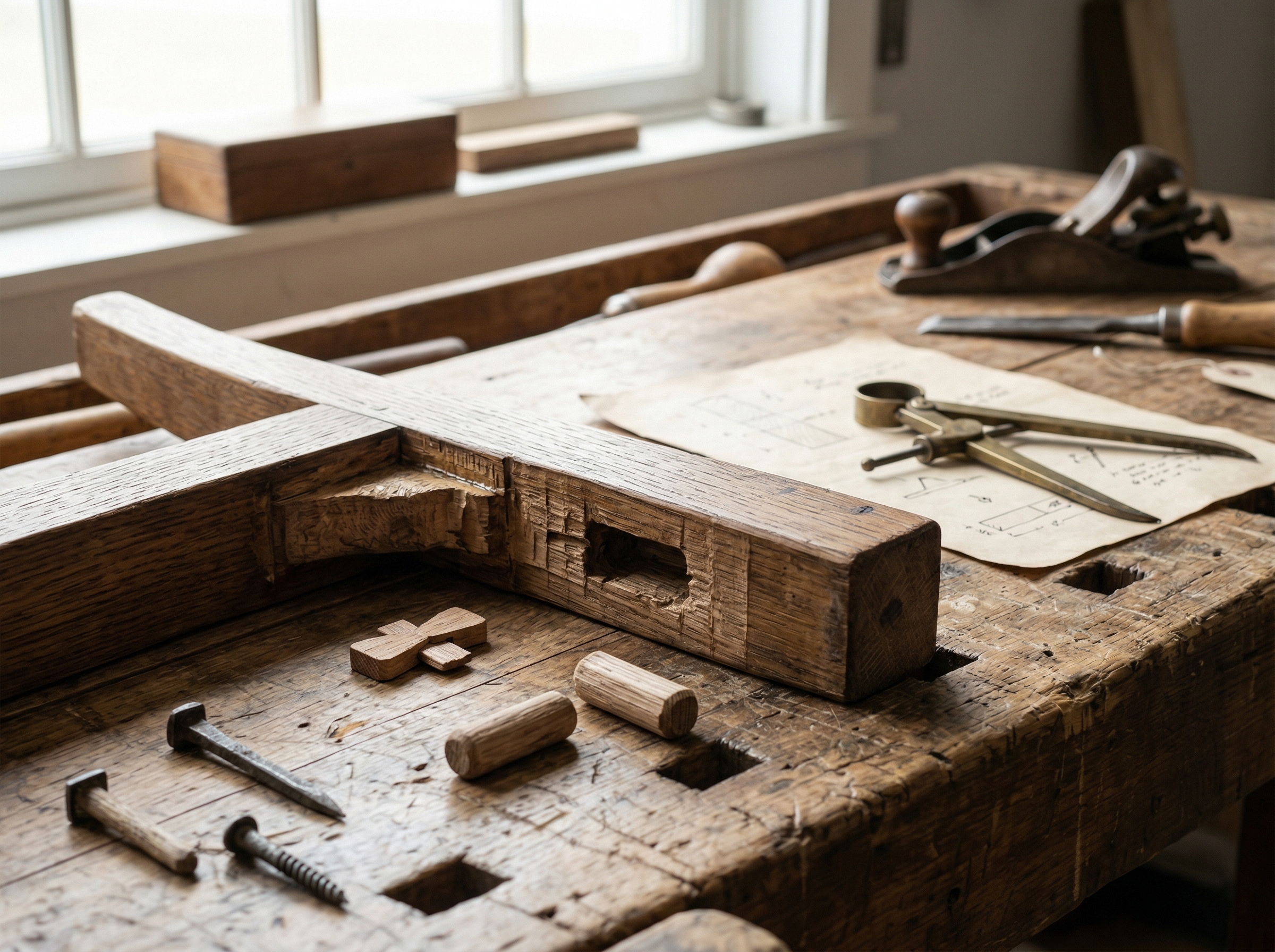
Construction and joinery tell you how a piece was made and when. Dovetails, mortise-and-tenon joints, and how drawers fit together are dead giveaways. Hand-cut dovetails with irregular spacing suggest pre-1860s work. Machine-cut dovetails with uniform spacing point to post-1860. Staples, particle board, and laminate? Modern production.
Hardware and fasteners change with technology. Hand-forged nails and rose-head screws indicate early work. Machine-cut nails appeared around 1790. Flathead screws with off-center slots are hand-filed and older. Phillips-head screws didn't exist until the 1930s. Brass pulls, hinges, and escutcheons also follow period styles—bail pulls, Chippendale brasses, Victorian porcelain knobs.
Wood type and finish narrow the field. Primary woods (what you see) and secondary woods (drawer sides, backs) were chosen regionally and by period. American Empire pieces often used mahogany veneer over pine. Mission furniture favored quarter-sawn oak. Mid-century modern leaned on teak and walnut. Finishes matter too—shellac, varnish, lacquer, and oil each have telltale signs.
Maker's marks, labels, and stamps are the most direct path to identification, but they're not always present. Check inside drawers, on the back panels, underneath seats, and along the bottom edges. Branded marks, paper labels, metal tags, and stamped numbers can name the maker, retailer, or factory. Even a partial mark helps.
Style and design elements connect a piece to a movement or period. Cabriole legs suggest Queen Anne or Chippendale. Tapered legs with inlay point to Federal or Hepplewhite. Bentwood curves? Thonet or similar steam-bent production. Chunky, straight lines with exposed joinery? Arts and Crafts or Mission.
What Photos to Take to Identify Furniture
The right photos make or break identification. You're not trying to win a photography contest—you're trying to capture evidence.
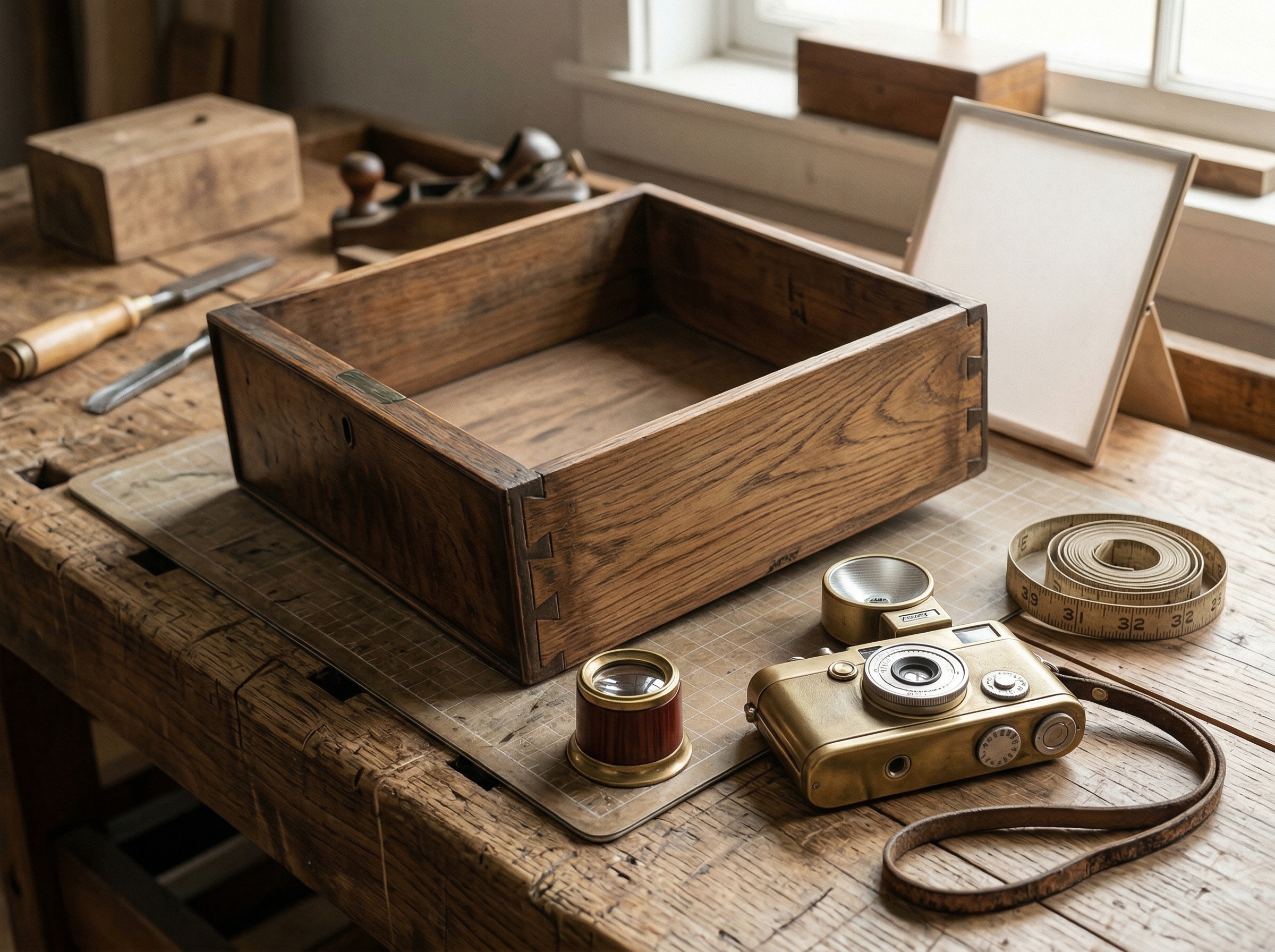
Full, well-lit shots from multiple angles establish the overall form. Shoot the front, back, and both sides in natural light or bright indoor lighting. Avoid harsh shadows. Show the piece as a whole so its proportions and silhouette are clear.
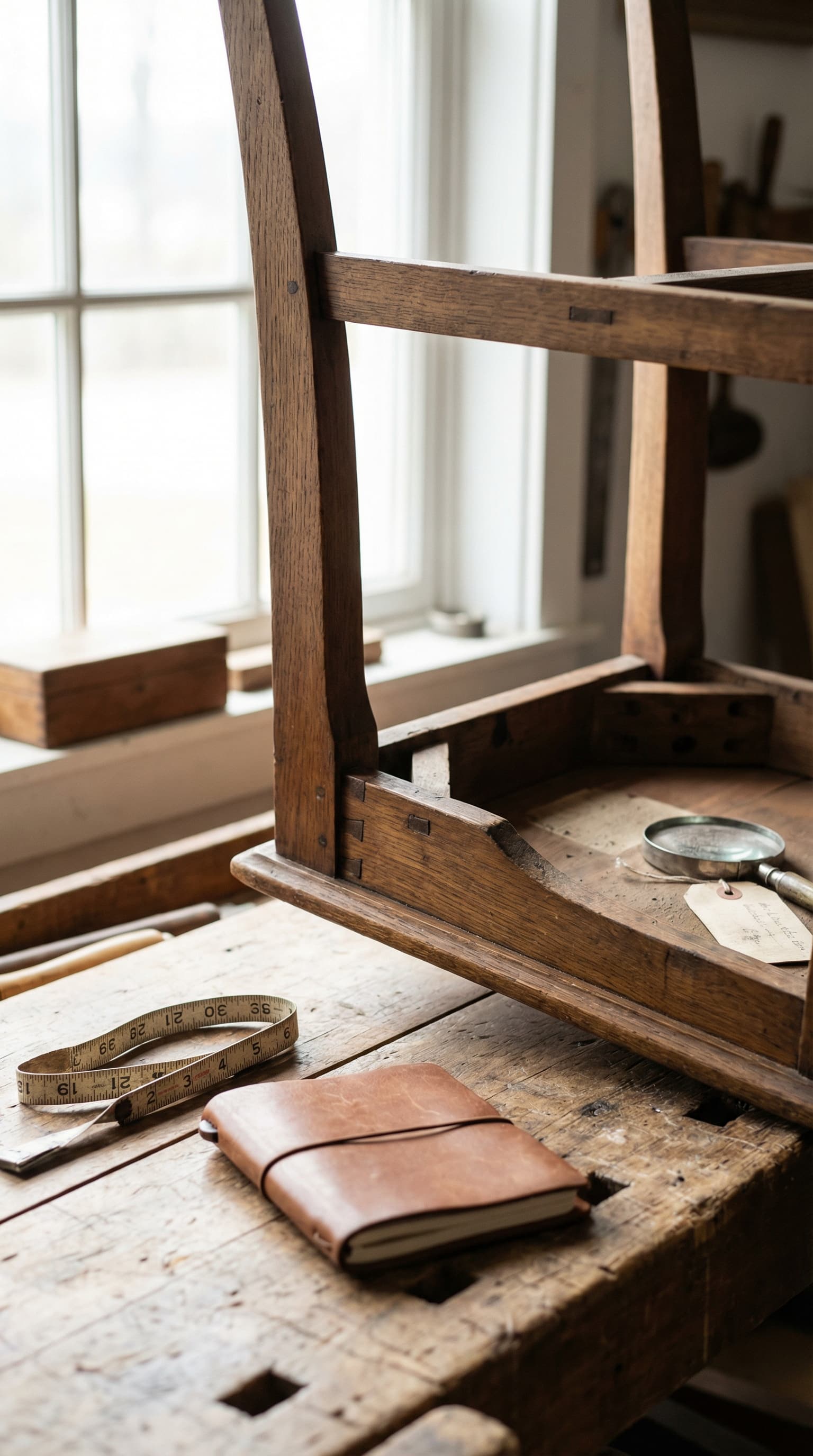
Close-ups of joinery and construction details are critical. Open drawers and photograph the dovetails, the drawer bottom, and how the drawer sides meet the front. Flip the piece over if you can and shoot the underframe, leg attachments, and any bracing. Check where the back panel attaches—nails, screws, or wooden pegs?
Hardware in sharp focus helps date and authenticate. Photograph pulls, hinges, locks, and keyhole escutcheons straight-on and in detail. If the hardware looks original, capture any wear, patina, or maker's marks on the metal itself.
Any marks, labels, or signatures need clear, readable shots. Use good lighting and get close enough to read text or numbers. Even faded or partial marks can be deciphered when the photo is sharp.
Finish and wear patterns tell a story. Photograph areas of wear—edges, handles, feet—where use has left marks. Capture the finish texture and color in natural light. Crazing, alligatoring, or shellac bloom are all useful clues.
If you're unsure what matters, err on the side of too many photos. You can always ignore the extras, but you can't identify furniture from photos you didn't take.
Common Misidentifications to Avoid
Certain furniture types trip people up again and again.
"Colonial" is not a furniture style. It's a historical period, and it's constantly misapplied to anything vaguely old-looking or dark-stained. What most people call Colonial is often Victorian, Edwardian, or even mid-20th-century reproduction work. Look at the joinery and hardware instead.
Reproduction vs. period pieces cause endless confusion. High-quality reproductions from the 1920s-40s can look convincingly old. Check for modern fasteners, uniform machine work, and overly perfect finishes. Wear should be logical—handles, feet, edges—not artificially distressed.
Veneer doesn't mean cheap. Fine antique furniture used veneers extensively to show off expensive, exotic woods. A well-executed veneer over solid secondary wood is a mark of quality craftsmanship, not corner-cutting. Veneer over particle board or plywood? That's modern production.
"Oak" and "mahogany" get misidentified constantly. Stain changes everything. A piece of birch or maple stained dark brown is often called mahogany. Quarter-sawn oak has a distinct ray fleck pattern; plain-sawn oak looks different. Learn to spot grain patterns, not just color.
Maker attribution requires evidence. A piece "in the style of Stickley" is not a Stickley unless it's marked. Likewise, a Victorian chair with ball-and-claw feet isn't automatically Chippendale—it's Victorian Revival. Style can be copied; provenance requires proof.
What Tocuro Helps You Identify Furniture From Photos
Once you've gathered the right photos, you need a way to connect them to answers. Tocuro analyzes your photos and identifies furniture by matching construction details, design elements, hardware, and marks against a broad base of market and reference data.
Upload your images—full views, joinery, hardware, marks—and Tocuro returns a name, style, likely period, and estimated value range based on current market signals. It's not a formal appraisal, but it gives you the information you need to know what you have and what it's worth in today's market.
Whether you're identifying a single antique chair, sorting through an estate, or evaluating a potential purchase, Tocuro helps you move from "What is this?" to "Here's what I know" in minutes. It's built for collectors, resellers, and anyone who needs answers without waiting days for an expert response.
For related guidance on identifying antiques beyond furniture, see Identify My Antique: How to Get Accurate Answers From Photos. If you're ready to understand value alongside identification, check out How to Value My Antique Furniture: A Practical Guide for Collectors.
Ready to Identify Your Furniture?
Stop guessing. Take the right photos, focus on the clues that matter, and let Tocuro connect the dots. Whether you're dealing with a mystery heirloom or a promising flea market find, you'll get clear answers fast.
Identify Your Item now and see what you're really looking at.
Photo identification
Identify Your Furniture
Use Tocuro to identify your item from a photo and get an estimated value range when market data is available.