
Gold Jewelry Marks: How to Read Karat Stamps and Hallmarks
Gold jewelry marks tell you the metal purity and sometimes the maker, but understanding where to find them and what they actually mean helps you identify your pieces accurately. This guide covers how to locate stamps, common marks you'll encounter, frequent misreads, and why clear photos matter.

Gold Jewelry Marks: How to Read Karat Stamps and Hallmarks
That tiny stamp inside your gold ring or on the clasp of your bracelet holds important clues about what you own. Gold jewelry marks typically indicate the purity of the metal and sometimes identify the maker, but they don't tell the whole story. Understanding these marks helps you know what you're looking at, though other factors determine actual value.
Where to Find Gold Jewelry Marks
Gold marks hide in predictable spots, but you'll need good light and sometimes a loupe to spot them.
Rings carry marks on the inside of the band, usually near the bottom where the metal is thickest. Wide bands might have marks closer to one edge. Estate rings sometimes have worn marks that are barely visible.
Bracelets and necklaces typically show marks near the clasp or on a small rectangular tag soldered to the chain. Link bracelets may have marks on the interior of one link or on the clasp tongue itself.
Earrings get tricky. Posts often have marks on the back of the earring or on the post itself. Older screw-backs sometimes carry marks on the finding's interior surface. Hoops may be stamped on the interior near the closure.
Brooches and pins usually have marks on the back of the piece or on the pin stem. Look near the catch or hinge where there's enough metal to hold a clear impression.
Some pieces have no marks at all. That doesn't automatically mean they're not gold—small pieces, older European jewelry, or items that have been resized might have lost their original stamps.
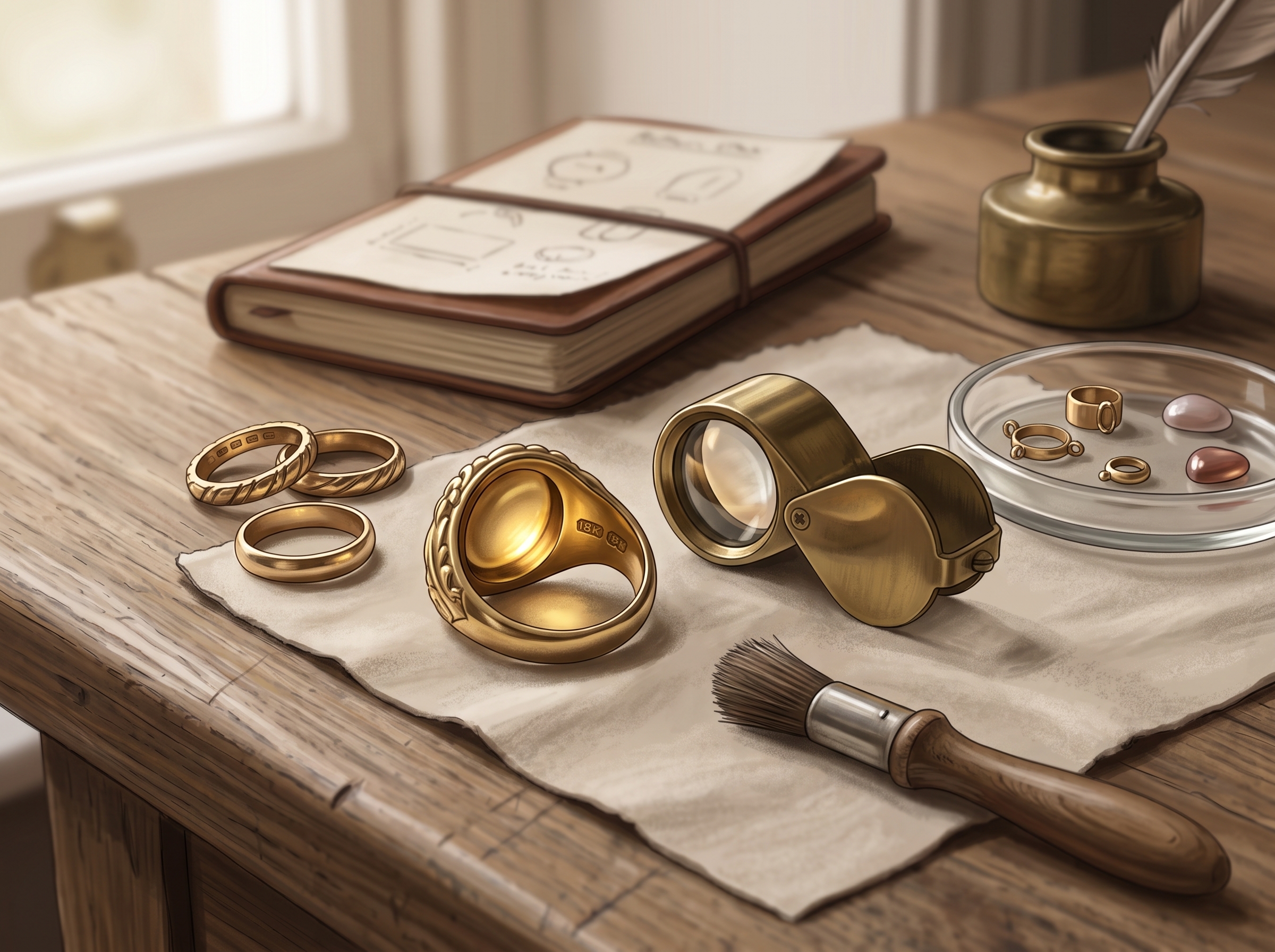
What Gold Jewelry Marks Can and Cannot Tell You
What the Marks Reveal
Karat stamps tell you the gold content. In the US system:
- •10K = 41.7% gold
- •14K = 58.3% gold
- •18K = 75% gold
- •22K = 91.7% gold
- •24K = 99.9% gold (pure)
European marks use a millesimal system:
- •417 = 10K
- •585 = 14K
- •750 = 18K
- •916 = 22K
- •999 = 24K
Manufacturer marks or maker's marks appear as initials, names, or symbols. These can help date a piece and identify its origin, especially with well-documented makers.
Country marks like the British hallmark system include additional symbols indicating the assay office, date letter, and sometimes the maker. These provide detailed provenance when you can decode them.
What the Marks Don't Tell You
Gold jewelry marks don't indicate:
- •Current market value – Weight, design, condition, maker reputation, and gemstones all matter more than the stamp alone
- •Age with precision – A 14K stamp could be from 1920 or 2020 without additional context
- •Authenticity guaranteed – Fraudulent marks exist, and testing may still be needed
- •Gemstone quality – That diamond could be high quality or heavily included; the gold mark says nothing about stones
- •Collectibility – Designer pieces or period jewelry can be worth far more than melt value regardless of karat
The stamp confirms metal content when authentic, but it's just one data point.
Common Misreads of Gold Jewelry Marks
Many marks look similar under magnification, leading to frequent confusion.
"10K" versus "18K" – Worn stamps can make a 1 look like an 8, especially on older pieces. The metal color can help: 10K is paler than 18K because it contains less gold.
"GP", "GF", "GE", and "RGP" – These indicate gold plating or gold fill, not solid gold. "14K GP" means 14-karat gold plated. "1/20 14K GF" means gold-filled with 1/20th of the weight being 14K gold. These are completely different from solid karat gold and worth considerably less.
Three-digit European marks – Numbers like "585" confuse people familiar only with US karats. They mean the same thing—585 equals 14K—but use a different numbering system.
Fake or fantasy marks – Some costume jewelry carries marks like "14KT HGE" (heavy gold electroplate) that sound more valuable than they are. The full mark matters, not just the karat number.
Worn or partial stamps – A mark that reads "14" might be worn 14K, or it might be a different mark entirely. Assuming what the rest said leads to errors.
If a mark includes "P", "F", "E", or "HGE" after the karat number, you're looking at plated or filled jewelry, not solid gold.
How Photos of Gold Jewelry Marks Improve Results
Clear photos of marks make identification more accurate and help distinguish solid gold from plated pieces.
Mark Close-ups
- •Best approach: Use a smartphone macro mode or loupe attachment
- •Why it matters: Full marks including suffixes reveal whether you have solid gold or plating
Natural Light Angles
- •Best approach: Rotate the piece under bright indirect light until the stamp is most visible
- •Why it matters: Low-angle light creates shadows that make shallow stamps readable
Metal Color Context
- •Best approach: Include a wider shot showing the overall piece color
- •Why it matters: 10K looks different from 18K; rose gold has copper tones; white gold appears silver
Scale Reference
- •Best approach: Capture the mark in context of the piece or with something for size
- •Why it matters: Tiny marks on delicate chains read differently than bold stamps on heavy rings
Multiple photos showing the mark from different angles give the most complete picture, especially when the stamp is worn or in shadow.
For identification including estimated value ranges based on market signals (not formal appraisals), Tocuro analyzes your photos. Upload clear images of any marks along with the full piece. You get 7 free identifications per day, and the count resets daily. Tocuro helps you understand what you have, though actual selling price depends on finding the right buyer and market conditions at that moment.
Gold jewelry marks give you essential information about metal purity, but they're the starting point, not the finish line. Combined with photos of the full piece, design details, and any maker's marks, you'll have what you need to identify and understand your jewelry properly. For related guidance on other jewelry identification features, see How to Identify Vintage Jewelry: Hallmarks, Clasps, and Photo ID.
Photo identification
Identify Your Jewelry Mark
Use Tocuro to identify your item from a photo and get an estimated value range when market data is available.