
Furniture Style Guide: How to Identify and Name Your Pieces
A practical furniture style guide that helps you identify and name furniture using visual details, clear classification tips, and photo-based identification strategies.
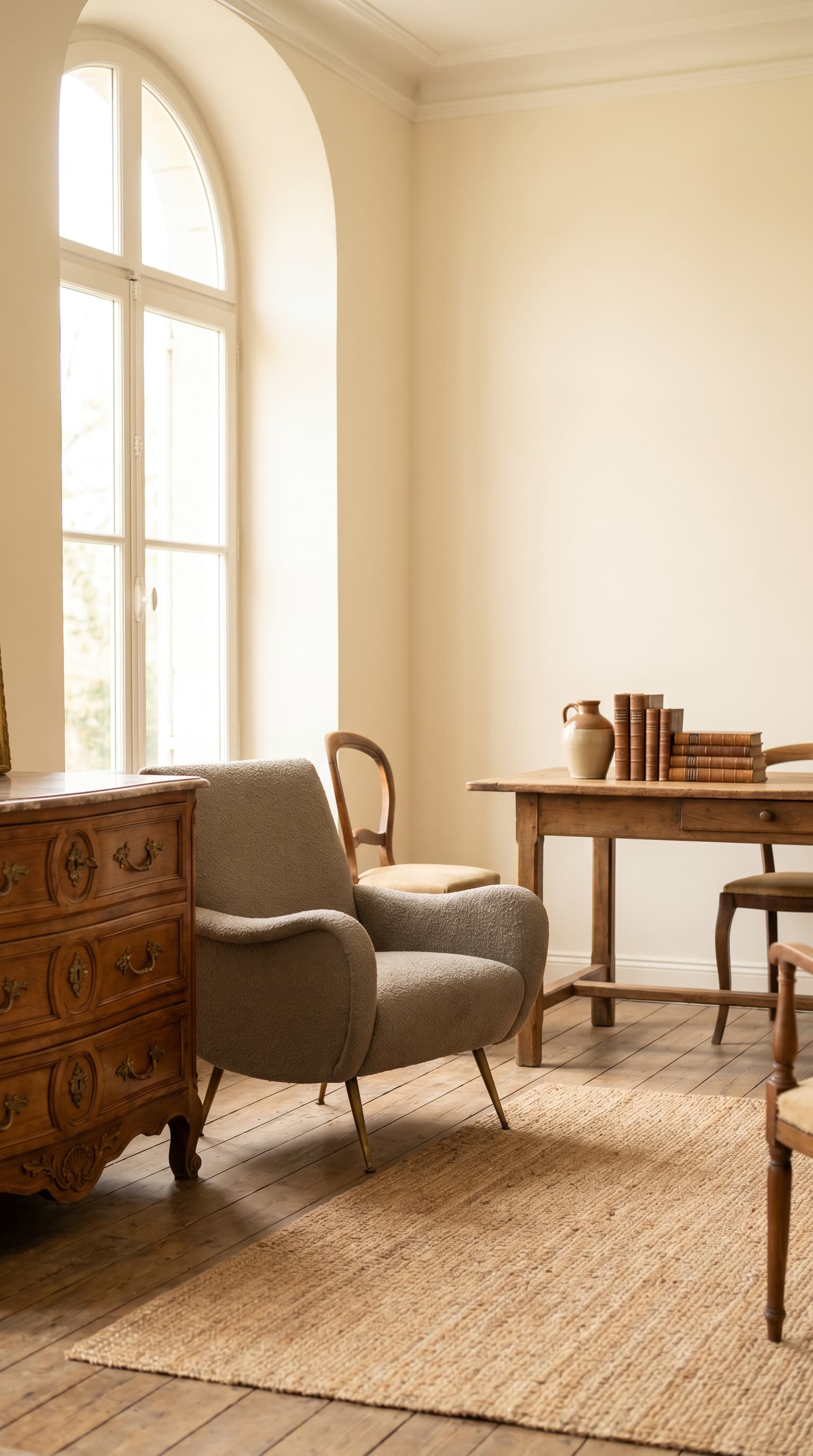
What You're Actually Trying to Name
When you look at a dresser, table, or chair and wonder "what style is this," you're asking several questions at once: When was it made? Where did it come from? What design tradition influenced it? A furniture style guide helps you break down those questions into visual clues you can actually spot.
Furniture styles aren't just academic labels—they're shorthand for construction methods, typical materials, and market expectations. Calling something "Mid-Century Modern" versus "Colonial Revival" changes how you research it, what you expect to pay, and where you might sell it. The right style name opens doors to accurate information.
Most people start with a hunch based on overall shape or a single detail. That's fine, but furniture rarely announces its style with one feature. You're looking for clusters of clues that point to the same period and aesthetic tradition. This guide gives you the checklist to confirm or correct your first impression.
Visual Classification Checklist for Furniture Style Guide
Start with the big picture, then zoom in. These categories help you narrow the field fast.
Overall Silhouette and Proportion
Look at the piece from across the room. Victorian styles tend toward curves, ornament, and vertical emphasis. Arts and Crafts leans blocky and horizontal. Mid-Century Modern sits low with clean geometry. Chippendale and Queen Anne show refined curves with cabriole legs. Federal and Sheraton favor straight lines with delicate inlay.
Leg and Foot Style
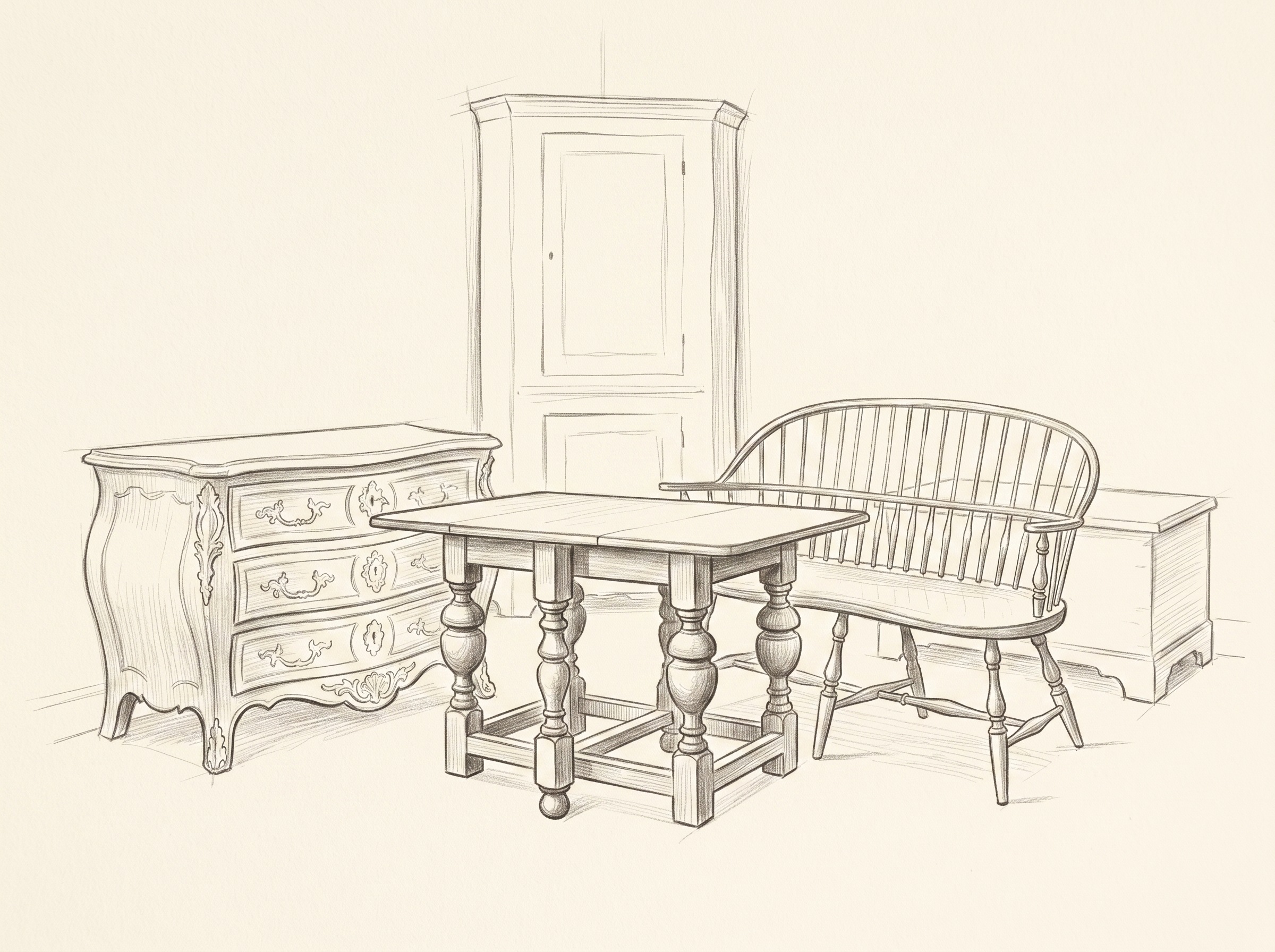
Legs are the fastest identifier. Cabriole legs (curved, ending in a foot) suggest Queen Anne, Chippendale, or French Provincial. Turned legs (lathe-shaped) appear in Colonial, Jacobean, and Victorian. Tapered legs point to Federal, Hepplewhite, or Sheraton. Straight, square legs often mean Mission, Shaker, or modern styles.
Ornamentation and Carving
Victorian pieces pile on carved fruit, flowers, and scrolls. Chippendale uses ball-and-claw feet and carved shells. Federal and Sheraton prefer inlay, banding, and light decorative painting. Arts and Crafts avoids applied ornament—exposed joinery is the decoration. Mid-Century Modern skips carving entirely, relying on wood grain and form.
Hardware and Joinery
Brass pulls with bail handles suggest Georgian, Federal, or Colonial Revival. Glass or ceramic knobs point to Victorian. Exposed dovetails and through-tenons identify Arts and Crafts. Hidden joinery and simple pulls indicate Mid-Century or later production. Hand-cut dovetails (irregular spacing) versus machine-cut (perfect spacing) help separate antique from reproduction.
Wood and Finish
Mahogany dominated Georgian, Federal, and Victorian high-style work. Walnut appears in Queen Anne, Victorian, and Mid-Century. Oak anchors Arts and Crafts and Golden Oak styles. Pine, maple, and cherry suit Colonial and Country pieces. Dark stains suggest Victorian or Mission. Natural or blonde finishes point to Mid-Century Scandinavian or 1950s American.
Construction Clues
Look underneath and inside. Thick, irregular saw marks suggest pre-1850 production. Circular saw marks start around 1850. Plywood appears after 1900, becoming standard in Mid-Century work. Solid wood backs and drawer bottoms indicate older or higher-quality pieces. Particle board and staples mean late 20th century onward.
Common Furniture Style Guide Confusions
Some styles share visual DNA. Others get mislabeled so often the wrong name sticks. Here's where people stumble.
Victorian Versus Eastlake
Both are Victorian-era, but Eastlake (1870s-1890s) reacts against earlier Victorian excess. Eastlake emphasizes geometric incised carving, straight lines, and visible construction. Earlier Victorian (Rococo Revival, Renaissance Revival) loves curves, applied ornament, and marble tops. If it's rectilinear with shallow, angular carving, think Eastlake.
Mission Versus Arts and Crafts
Mission is American Arts and Crafts, but not all Arts and Crafts is Mission. Gustav Stickley's severe oak pieces define Mission. English Arts and Crafts (William Morris influence) allows more decoration and variety. Mission furniture avoids ornament almost entirely—it's all about exposed joinery and simple forms.
Colonial Versus Colonial Revival
True Colonial furniture dates to the 1600s-1700s. Colonial Revival imitates it, starting in the 1870s and peaking in the 1920s-1940s. Revival pieces use machine joinery, more uniform wood, and sometimes shortcuts like veneer where originals used solid stock. The style looks similar, but the age and value differ dramatically.
Mid-Century Modern Versus Danish Modern
Danish Modern is a subset of Mid-Century Modern, emphasizing teak, organic curves, and refined joinery. American Mid-Century uses walnut, molded plywood, and bolder geometry. Both share the 1945-1970 timeframe and clean aesthetic, but Danish work tends lighter and more sculptural. Check wood type and country of origin.
French Provincial Versus French Rococo
French Provincial simplifies high-style French Rococo for country use. Both feature cabriole legs and curves, but Provincial skips heavy gilding and elaborate carving. Rococo (Louis XV) goes full-tilt with asymmetry, ormolu mounts, and intricate marquetry. Provincial uses solid wood, simpler carving, and regional wood species.
How to Use Photo Identification to Narrow It Down
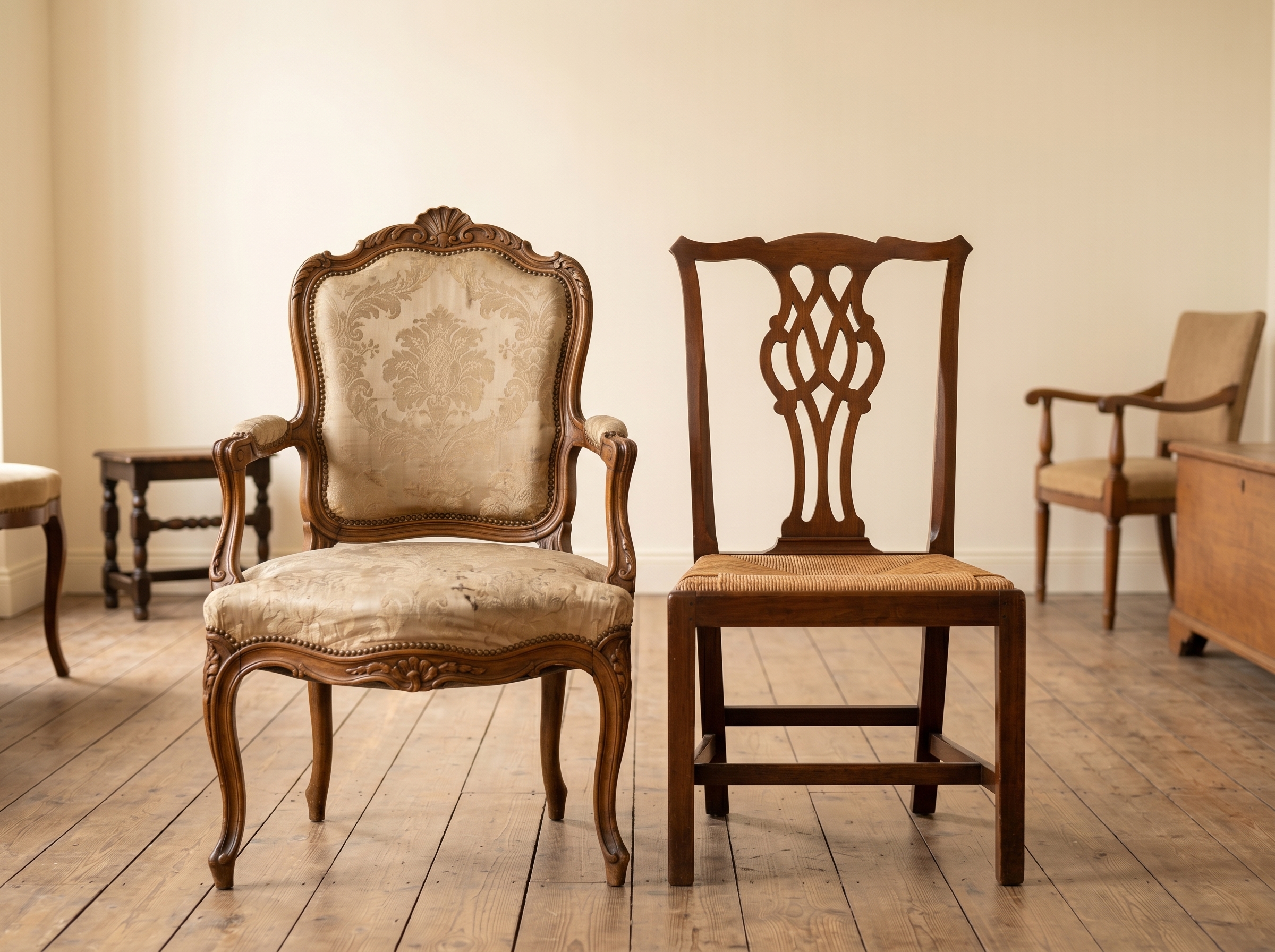
Photos reveal what words miss. When you're working through a furniture style guide, the right images confirm or eliminate candidates fast.
Capture Multiple Angles
Overall front, back, sides, and top views show proportion and construction. Close-ups of legs, feet, hardware, carving, and joinery provide the details that separate one style from another. Don't skip the underside—dovetails, saw marks, and maker's marks hide there.
Focus on Diagnostic Details
If you're choosing between two styles, photograph the features that distinguish them. Trying to confirm Chippendale? Get a clear shot of the leg and foot. Wondering if it's true Federal or a later copy? Photograph the inlay and hardware up close. Blurry overview shots waste time.
Show Construction and Wear
Open drawers and photograph the interior joinery. Flip chairs to show undercarriage construction. Capture finish wear, patina, and any repairs. These details don't always confirm style, but they confirm age and authenticity, which narrows the style window.
Use Consistent Lighting
Natural indirect light works best. Harsh flash flattens detail and distorts color. Good lighting reveals wood grain, carving depth, and finish quality—all useful for style identification. If the photo can't show the detail clearly, your eye caught something the camera didn't, and you need to adjust.
Compare to Reference Images
Once you have solid photos, compare them to verified examples. Museum collections, auction archives, and furniture style resources offer reference points. Look for matches in leg style, ornamentation, proportion, and construction. If three features align, you're likely on track.
Photo-based tools speed this process. Tocuro analyzes your images and compares them to known examples across styles and periods, returning probable matches in minutes. It's faster than flipping through reference books and broader than relying on memory.
Get a Clear Answer From Your Photos
Working through a furniture style guide manually takes patience and a good eye. You can cross-reference details, compare proportions, and still end up with two or three plausible candidates. Tocuro lets you upload photos and get identification results based on visual analysis of your specific piece.
The tool compares your images against thousands of known examples, highlighting style, period, and likely materials. It's especially useful when you're stuck between similar styles or when a piece blends influences. You'll get results that point you toward the right name and research direction, helping you move past guesswork.
If you're serious about identifying furniture accurately, photo-based identification tools belong in your process. Combined with hands-on inspection and a solid understanding of how to identify furniture style, you'll name pieces with confidence and back up your conclusions with evidence.
Photo identification
Identify Your Furniture
Use Tocuro to identify your item from a photo and get an estimated value range when market data is available.