
Brass Candlestick Identification: How to Read Casting Seams and Marks
Identifying brass candlesticks requires examining specific construction clues that reveal age, origin, and manufacturing method. This guide shows you where to look for casting seams, how to spot maker's marks, and which photo angles matter most for accurate identification.
Brass Candlestick Identification: How to Read Casting Seams and Marks
That heavy brass candlestick you found at an estate sale might be a 17th-century English piece—or a 1970s import. Brass candlestick identification depends on reading subtle construction clues that photos can reveal, from the barely-visible seam running down the side to the tiny mark hidden under the base. Unlike furniture with labeled drawers or jewelry with standard hallmarks, candlesticks hide their stories in places most people never think to photograph.
The right photos tell you whether you're holding cast brass or spun, whether it's genuinely old or deliberately aged, and sometimes even which foundry made it. Here's what actually matters.
What Clues Matter for Brass Candlestick Identification
Casting Seams and Construction Lines
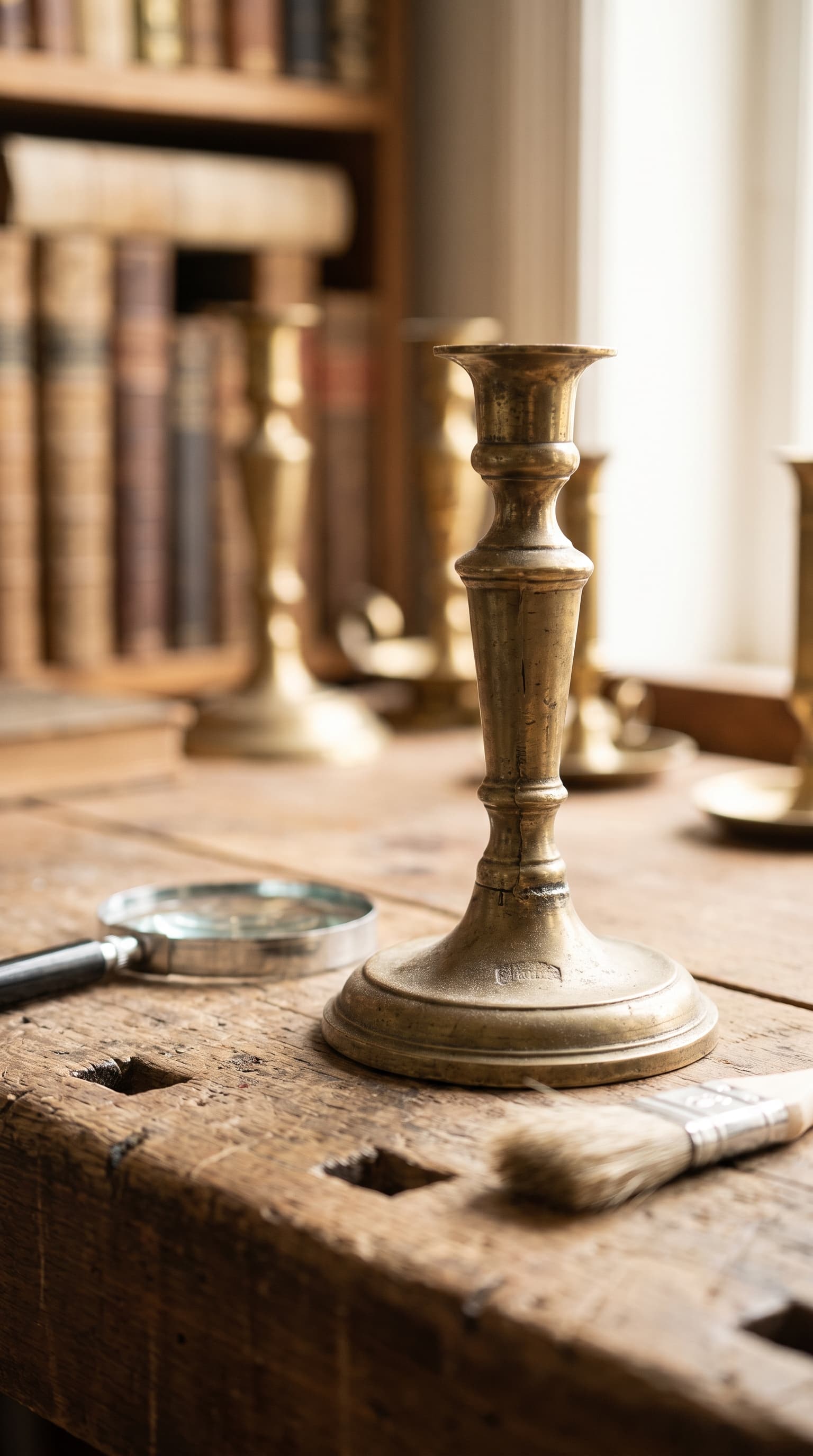
Casting seams are your first checkpoint. Genuine antique brass candlesticks made before 1850 show hand-finishing marks where two mold halves met. Look for a faint vertical line running from base to drip pan—it won't be perfectly smooth because it was filed by hand. Machine-cast pieces from the 1880s onward often have sharper, more regular seams or none at all if they were spun on a lathe.
Seamed candlesticks that feel too light for their size often signal thin-walled 20th-century reproductions. Period pieces have heft.
Base Construction and Assembly
Flip the candlestick over. The base reveals whether parts were cast as one piece or assembled. Threaded connections (where the stem screws into the base) became common after 1820. Earlier candlesticks often show brazing or soldering where components join. You'll see a slightly different color or texture at these joints.
A perfectly smooth, one-piece casting with no visible joins typically indicates either very high-quality 18th-century work or modern manufacturing.
Patina and Wear Patterns
Authentic age shows in patina distribution. Old brass darkens unevenly—deeper in recesses, lighter on high points where hands gripped it for decades. The base rim wears from being set down repeatedly. New brass that's been artificially aged often looks uniformly darkened or has patina in odd places (like deep in the candle cup where wax would have protected it).
Check inside the candle socket. Genuine use leaves irregular wax residue and oxidation. Reproductions often have pristine interiors.
Maker's Marks and Touchmarks
Brass candlestick marks hide in three spots: stamped into the base underside, struck on the rim edge, or occasionally on the stem. English candlesticks from the 1700s-1800s sometimes carry initials or small symbols. Continental pieces might show city marks or maker's stamps.
Many genuinely old candlesticks carry no marks at all. Absence of marking doesn't mean fake—it often just means provincial manufacture or that the piece predates consistent marking practices.
Design Details and Proportions
Period-specific design elements matter more than you'd expect. Mid-drip pans (the disk partway up the stem) appeared consistently on 18th-century English candlesticks but were rare on Continental examples. Baluster shapes evolved over time—compare the turnings to documented examples from known periods.
Beware of design mashups: a Queen Anne-style base with Victorian detailing usually signals reproduction.
What Photos to Take for Brass Candlestick Identification
Get the angles that reveal construction, not just decoration.
Full side profile in natural light. Position the candlestick so light rakes across it from the side. This makes casting seams and wear patterns visible. One clear side shot tells more than a dozen fuzzy close-ups.
Base underside, well-lit. Use a flashlight and shoot straight down at the base bottom. Capture any marks, assembly methods, or numbers. If there's a felt pad glued on, peel back a corner—marks often hide underneath.
Close-up of any seams. Zoom in where mold halves met. The seam's sharpness and finish method help date manufacturing.
Candle socket interior. Shoot down into the top opening. Wax residue, oxidation patterns, and interior finishing all matter.
Any stamps or marks at 2-3x magnification. Even partial marks help. Photograph marks both as-is and after gentle rubbing with a soft cloth to remove surface dirt.
Weight context. Set the candlestick on a kitchen scale in the photo. Weight-to-size ratio helps distinguish solid brass from brass-plated or hollow reproductions.
Like documenting bronze sculptures, lighting angle reveals surface character that flat lighting conceals.
Common Misidentifications in Brass Candlesticks
Brass-Plated Steel or Pot Metal
Many "brass" candlesticks are actually plated. A small magnet settles this instantly—brass isn't magnetic, but a steel core is. Plating often wears through at high points, revealing darker metal underneath. Genuinely brass candlesticks oxidize uniformly to the same warm tone throughout.
Reproduction Passed as Period
High-quality Indian and Chinese reproductions from the 1960s-1980s fool many collectors. They used traditional sand-casting methods and genuinely age over time. Look for too-perfect symmetry (modern lathes), anachronistic design combinations, or overly theatrical "age" (heavy pitting that doesn't match the wear pattern).
If every turned detail is mathematically identical on a "pair" of candlesticks, suspect modern production.
19th-Century Mistaken for 18th
Victorian brass candlesticks (1840s-1900) are often mislabeled as Georgian or earlier. The Victorians deliberately copied earlier styles. Threading at joins, machine-regular turnings, and thinner walls usually indicate the later period. Genuine 18th-century examples feel distinctly heavier for their size.
Converted Candlesticks
Lamps made from old candlesticks confuse identification. Drilled centers and added electrical fittings alter the piece. These conversions happened in every era from the 1890s onward, so "converted candlestick" doesn't guarantee age.
Regional Style Confusion
Dutch, English, French, and Spanish brass candlesticks followed different design languages. A piece with Spanish proportions stamped with fake English marks is a common trap. Understanding regional characteristics takes time—misattribution is easy when you're learning.
What Tocuro Can Help Resolve
When you're trying to brass candlestick identification from a pile of estate sale finds, Tocuro spots details you might miss. Upload photos of your casting seams, base marks, and overall form—the app cross-references construction methods, design elements, and known maker's marks to narrow down period and origin.
Tocuro identifies items from photos and provides estimated value ranges based on current market signals. You get 7 free identifications per day (the count resets daily), plenty for working through a collection or testing pieces before you invest time in deeper research. The estimated value isn't a formal appraisal, but it gives you real-world context for what similar pieces are actually selling for.
The app handles the comparison work—matching your candlestick's proportions and details against documented examples—while you focus on the hands-on examination. It's particularly useful when you're stuck between "probably old" and "definitely reproduction" on a borderline piece.
Get Your Brass Candlestick Identified
Good photos beat guesswork every time. Capture those casting seams in raking light, flip the piece over for base details, and photograph any marks you find. Upload your photos to Tocuro and get an identification based on the construction clues that actually matter—from mold lines to maker's marks to period-specific proportions.
Whether you're sorting inherited pieces or building a collection, knowing what you're looking at makes all the difference.
Photo identification
Identify Your Item
Use Tocuro to identify your item from a photo and get an estimated value range when market data is available.