
Brass Bronze Marks: How to Find and Read Foundry and Workshop Stamps
A practical guide to locating and interpreting foundry marks, workshop stamps, and patent numbers on brass and bronze objects—plus what marks can and cannot reveal about age, origin, and value.
Brass Bronze Marks: How to Find and Read Foundry and Workshop Stamps
Brass and bronze objects—from candlesticks and door hardware to sculptures and scientific instruments—often carry marks that tell part of their story. These brass bronze marks can include foundry stamps, maker's names, patent numbers, and designer signatures. Unlike hallmarks on precious metals, these marks are less standardized and more varied in placement, style, and meaning. Knowing where to look and what to expect helps you gather clues about origin, age, and sometimes value.
Where to Find Brass Bronze Marks on Cast Metal Objects
Marks on brass and bronze pieces appear in places that don't interfere with the object's function or appearance. The most common locations:
Bases and undersides are the primary spots. Turn over candlesticks, bookends, figurines, and decorative bowls. Marks are often cast into the base during manufacturing or stamped afterward.
Backs and hidden surfaces matter for wall-mounted hardware, door knockers, and plaques. Check the reverse side, especially near edges or mounting points.
Rims and edges sometimes carry small stamps. Clock bezels, tray edges, and lamp bases may have marks that wrap around or sit on a flange.
Inside surfaces apply to hollow objects like urns, vases, and boxes. Look inside the lip or on interior walls where the foundry could access the piece during finishing.
Patent plates and cartouches appear as raised rectangles or ovals on larger pieces. These were intentionally visible and often include dates, patent numbers, or maker information.
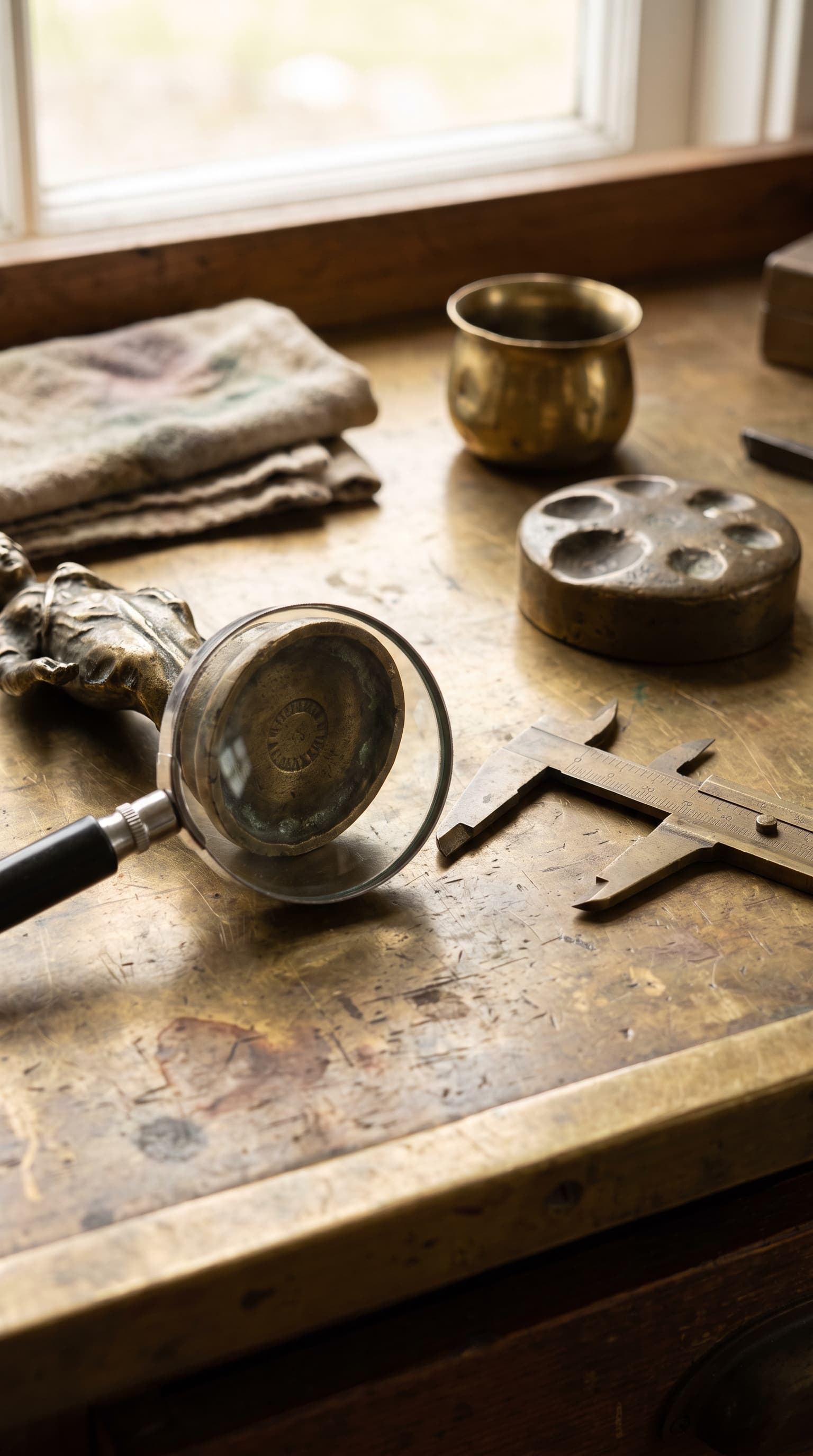
Marks can be raised (cast into the mold), incised (carved or engraved after casting), or stamped (punched with steel dies). Foundry marks tend to be subtle and may require good lighting and magnification to read clearly.
What Brass Bronze Marks Can and Cannot Tell You
Foundry and workshop marks on brass and bronze objects provide useful context, but they have limits.
What marks can reveal
Maker or foundry name helps establish origin. Well-documented foundries like Bradley & Hubbard, J.B. Hirsch, or European firms like Ferdinand Barbedienne often increase collector interest. Many smaller regional foundries also marked their work.
Patent dates narrow the manufacturing window. A patent date tells you the piece could not have been made before that year, though production often continued for decades.
Designer signatures appear on art bronzes and decorative pieces. A sculptor's name—especially if well-known—affects value more than the foundry mark alone.
Model or catalog numbers help trace pieces through manufacturer records, catalogs, or advertisements. This can confirm original function, finish options, and retail context.
What marks cannot tell you
Exact manufacturing date is rarely pinned down by the mark alone. A foundry that operated 1880–1920 might have made an identical piece throughout that span.
Original finish or patina isn't indicated by most marks. Brass and bronze pieces were often lacquered, painted, or chemically treated, and those finishes change or disappear over time.
Whether it's solid brass or bronze vs. plated can't always be determined from marks. Many cast pieces are solid, but some hollow or pot-metal objects carry similar marks and were finished to look like bronze.
Value without context is hard to establish. A mark identifies the maker, but condition, rarity, style, and market demand drive value more than the mark itself.
Common Misreads of Brass Bronze Marks
Partially worn stamps, crude casting, and unfamiliar fonts lead to frequent misinterpretation.
Patent dates mistaken for manufacturing dates: Seeing "PAT 1895" doesn't mean your piece was made in 1895. It means the design was patented then. Production could have started years later or continued well into the 20th century.
Foundry marks confused with designer signatures: Some marks include both. A piece might read "A. Moreau" (sculptor) and "Susse Frères" (foundry). The sculptor's name often appears more prominently, but the foundry mark matters for provenance.
Numbers mistaken for dates: Model numbers, mold numbers, and size codes often look like years. A "22" might be a catalog number, not 1922.
Reproductions with original marks: Some vintage molds were reused or copied. A mark that matches a known maker doesn't guarantee the piece is period. Style, casting quality, patina, and weight provide additional clues.
Worn or partial marks: Casting flaws, grinding during finishing, or decades of wear can obscure letters. A partial "B & H" might be Bradley & Hubbard, but without more context it's hard to confirm.
Foreign marks misread as English: French, German, and Austrian foundries exported widely. "Déposé" (registered), "Geschützt" (protected), or "Brevete" (patented) are common European terms that look unfamiliar to English-speaking collectors.
How Photos of Brass Bronze Marks Improve Identification
Clear photos make it easier to identify makers, cross-reference catalogs, and assess authenticity. Here's what helps most:
Direct overhead lighting creates contrast. Raking light from the side emphasizes depth on cast or incised marks. Avoid harsh flash that washes out detail.
Close-up shots capture letter shapes, spacing, and font style. Even partial marks become more legible with magnification.
Multiple angles help when marks are on curved, textured, or recessed surfaces. A slight shift in angle can reveal letters hidden by shadow or patina.
Context photos show the whole object. Style, form, hardware, and finish often confirm or contradict what a mark suggests about age or origin.
Scale reference matters for small marks. Including a coin or ruler edge in one shot helps viewers judge size and detail.
When you photograph brass bronze marks, capturing both the mark and the object's overall character gives a fuller picture. A skilled eye can spot reproduction castings, modern patinas, or mismatched components that a mark alone wouldn't reveal.
If you're trying to identify a brass or bronze piece and want help reading the marks, Tocuro can analyze photos and provide context on makers, periods, and estimated value ranges based on market signals. Upload clear images of any marks, the full object, and detail shots—you'll get 7 free identifications per day, and the count resets daily.
Comparing Brass Bronze Marks to Other Collectible Categories
Understanding how brass and bronze marks differ from other maker's marks helps set realistic expectations.
Standardization and regulation
- •Brass and bronze marks: Voluntary, inconsistent formats; no legal standard
- •Jewelry and silver marks: Highly regulated hallmarks with legal accountability
Mark placement consistency
- •Brass and bronze marks: Varies widely by object type and foundry practice
- •Pottery and porcelain marks: Usually on the base, following maker tradition
Information density
- •Brass and bronze marks: Often just a name or patent number
- •Coin mint marks: Precise date, mint location, and designer initials
Public documentation
- •Brass and bronze marks: Catalogs and ads exist but are scattered; many small foundries are poorly documented
- •Glass maker marks: Better-documented major producers, though many small glassworks remain obscure
Practical Steps After You Find a Mark
Once you've located and photographed the mark, a few steps help you learn more:
Search foundry name plus "catalog" or "advertisements": Digital archives, library collections, and collector sites often host scans of original sales materials.
Check maker databases and collector forums: Many niche communities focus on specific foundries or object types. Experienced collectors can confirm marks or flag reproductions.
Compare similar objects: Auction archives, museum collections, and online marketplaces show how other examples were marked, finished, and described.
Consider the whole piece, not just the mark: Style, weight, casting quality, hardware type, and patina all contribute to authentication and dating.
Get a second opinion on valuable or unusual finds: If a mark suggests a notable maker or rare piece, a photo-based identification service or specialist appraiser can provide context. Tocuro offers estimated value ranges based on market signals—not formal appraisals—but enough to guide your next steps.
Brass and bronze marks are starting points, not final answers. They open doors to research, confirm suspicions, and sometimes surprise you with connections you didn't expect. The more you handle and photograph these pieces, the more patterns you'll recognize.
Photo identification
Identify Your Mark
Use Tocuro to identify your item from a photo and get an estimated value range when market data is available.