
Antique Glass Bottle Identification: How to Identify Old Bottles from Photos
Identifying antique glass bottles requires examining manufacturing clues visible in photos: seam lines, pontil marks, embossing sharpness, color variations, and base markings. This guide shows which details matter most, what photos to capture, and how Tocuro's photo identification can help date and value your bottles.
What Clues Matter for Antique Glass Bottle Identification
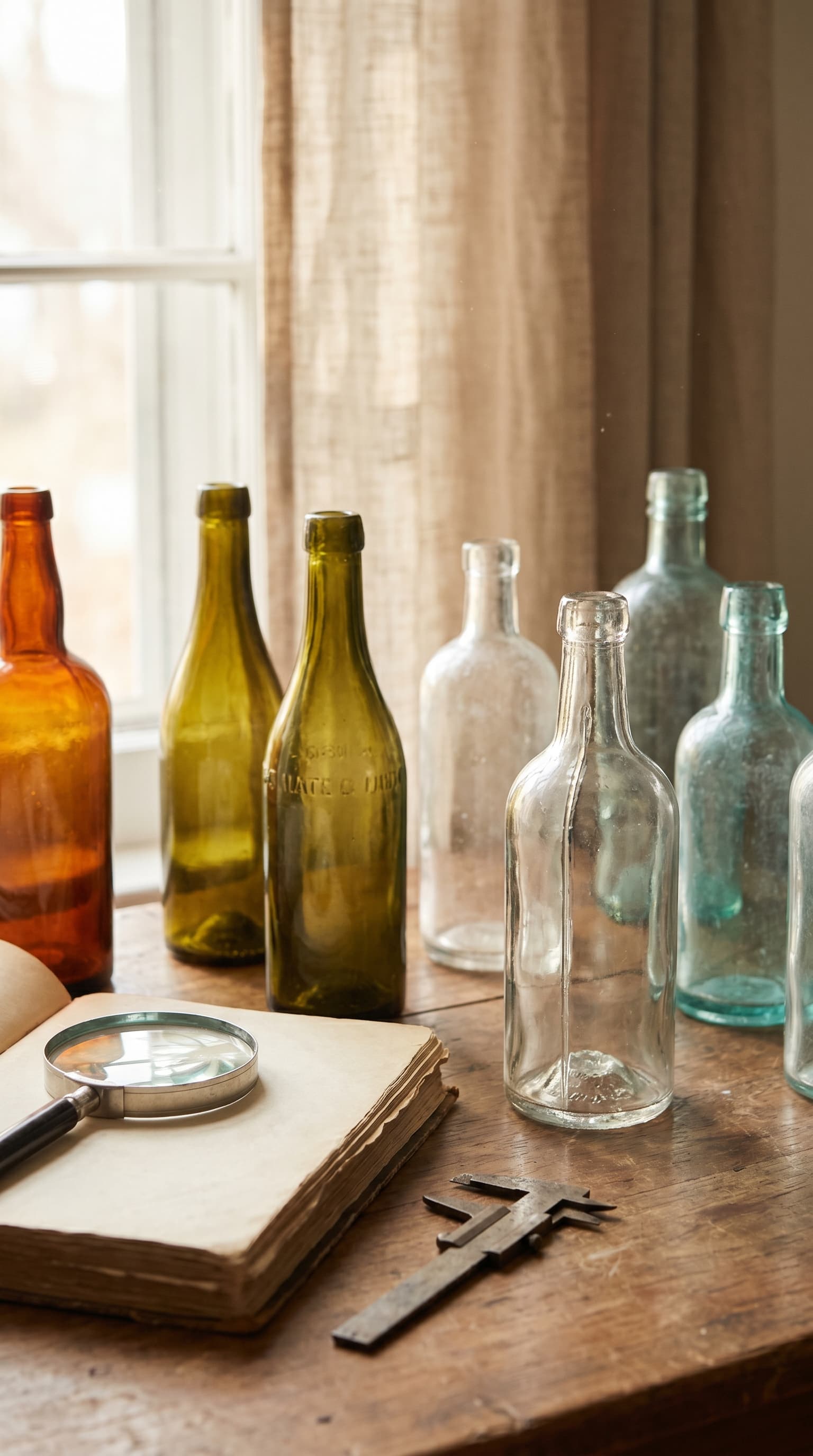
Identifying antique glass bottles starts with understanding what the glass itself tells you. Unlike furniture or ceramics, bottles reveal their age and origin through specific manufacturing traces that evolved over two centuries of glassmaking.
Seam Lines and Their Location
The mold seam is your first dating clue. Run your finger along the bottle's side—where does the seam stop?
Bottles made before the 1880s typically show no side seams or very faint ones that stop well below the neck. Hand-blown bottles were free-formed or finished in simple two-piece molds. A seam that runs all the way to the lip, including through it, indicates machine production from the early 1900s onward. The Owens Automatic Bottle Machine, introduced around 1903, left continuous seams as its signature.
Bottles from the 1880s–1910s transition period often show seams that reach the neck but stop before the finish—the top was still applied by hand.
Pontil Marks on the Base
Flip the bottle over. An antique glass bottle identification often hinges on what you find on the base.
A pontil mark is a scar left when the glassblower's rod (the pontil) was broken away. These marks disappeared as manufacturing standardized. Rough, irregular pontil marks suggest pre-1860 production. Smoother iron pontil marks appear on bottles from the 1840s–1870s. By the 1880s, most American bottles show smooth bases or simple mold markings instead.
Some reproductions fake pontil marks, but they're usually too uniform or paired with machine-made seams—a dead giveaway.
Embossing Sharpness and Style
Embossed lettering or designs can date a bottle, but the quality of that embossing matters as much as the text.
Sharp, crisp lettering with clear edges indicates a well-maintained mold and often earlier production runs. Worn, soft embossing suggests either late mold life or deliberate aging on reproductions. Font styles also shift by era—ornate Victorian scripts appear on 1880s–1900s bottles, while simple block letters dominate earlier utilitarian bottles.
Company names and address details are goldmines. Bottles listing only a city name usually predate those with full street addresses. Zip codes? Modern.
Glass Color and Clarity
Color variations in antique glass bottles come from impurities, additives, or environmental exposure.
Aqua and light green tints dominated 19th-century bottle production because iron impurities in sand turned glass these colors naturally. Deep cobalt blue, amber, and amethyst required deliberate additives and often indicate medicine, poison, or specialty product bottles. Sun-colored amethyst glass—clear bottles that turned purple from manganese reacting to UV light—points to bottles made between the 1880s and 1915.
Modern reproductions often use overly consistent color or odd shades that don't match historical production.
Base Markings and Maker's Marks
Numbers, letters, or symbols on the base can identify the manufacturer and narrow the date range.
Glass company logos became common after 1900. The Owens-Illinois Glass Company used variations of an "O" and "I" mark starting in 1929. Ball and Kerr marks appear on fruit jars from the early 1900s onward. Earlier bottles might show mold numbers or simple geometric patterns.
Absence of markings doesn't mean a bottle is worthless—many rare pre-1900 bottles were made by small glasshouses that left no signature.
What Photos to Take for Antique Glass Bottle Identification
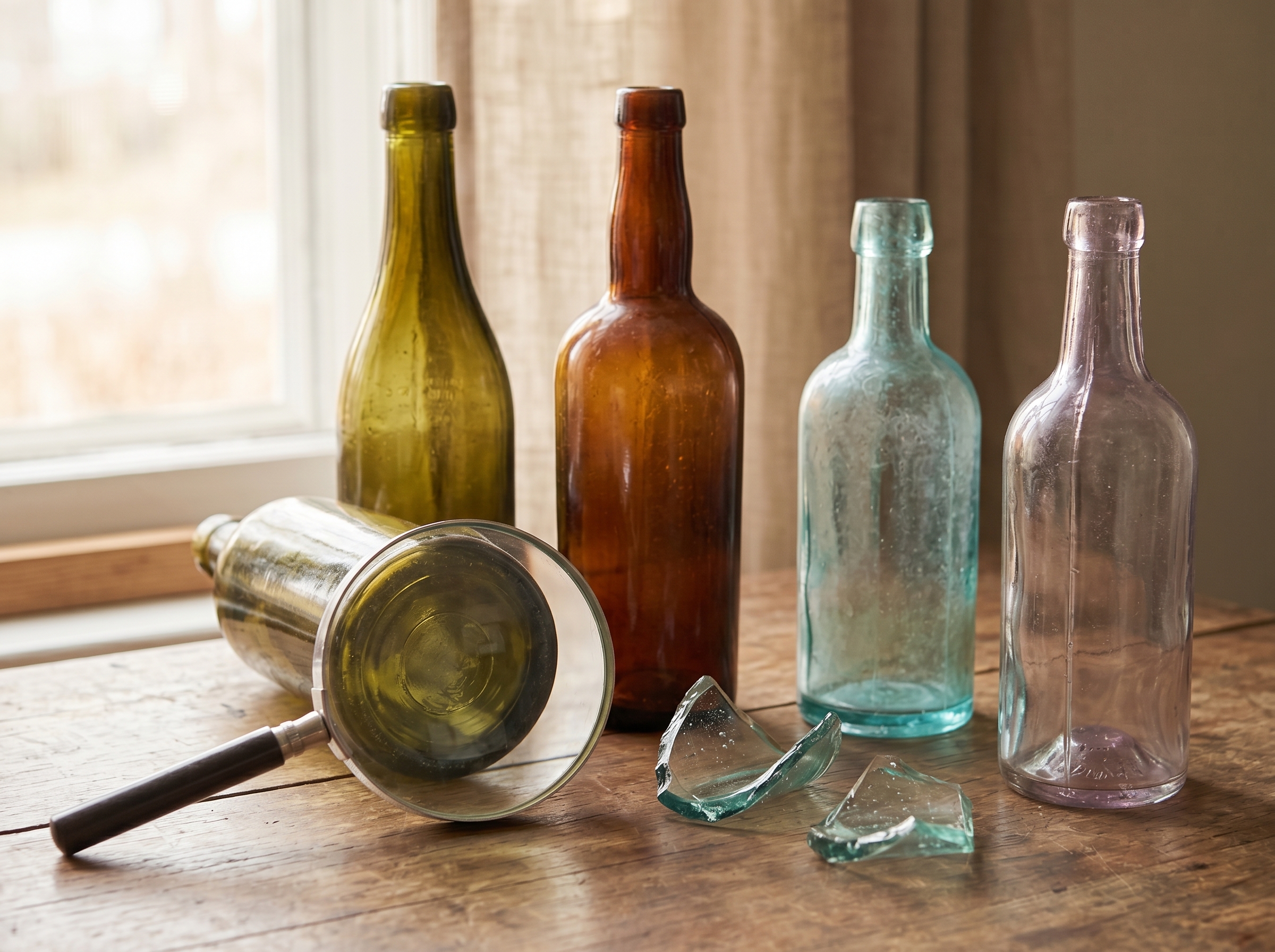
Good photos make identification accurate. Poor lighting or missing angles leave too much guesswork.
Full Bottle in Natural Light
Capture the entire bottle against a plain background. Natural daylight shows color and clarity best—indoor lighting can distort glass tones. Position the bottle upright and centered.
Close-Up of the Seam
Photograph the side seam from base to top. Get close enough that someone viewing the image can see where the seam ends—at the base, mid-neck, or all the way through the lip.
Base Detail
Shoot straight down at the base. This is where pontil marks, maker's marks, and mold numbers hide. Make sure any raised or embossed details are in focus.
Lip and Finish
The top of the bottle—the finish—varies wildly by function and era. A tight shot of the lip shows whether it's hand-tooled (with slight irregularities), machine-made (perfectly uniform), or has specific closures like crown caps or cork grooves.
Embossing or Labeling
If your bottle has embossed text, get a clear, angled shot where light highlights the raised letters. For paper labels, photograph them flat-on and include any visible wear, printing style, or tax stamps.
Color and Transparency Check
Hold the bottle up to light and photograph it. This reveals bubbles, swirls, and color depth that help distinguish handmade glass from modern production.
Common Misidentifications in Antique Glass Bottle Identification
Bottle collecting attracts plenty of hopeful thinking. Here's where people most often stumble.
Modern Reproductions Sold as Antiques
Reproduction bottles flood flea markets and online marketplaces. They mimic old styles—figured flasks, bitters bottles, historical flasks—but almost always show machine-made seams running to the lip. Check for pontil marks that look stamped rather than broken, and glass that's too clear or too evenly colored.
Confusing Patina with Age
Dirt, mineral deposits, and surface wear can make a 1970s bottle look "old." Real age shows in manufacturing details, not grime. Scratches and chips can happen to any bottle. Oxidation and iridescence—rainbow sheens from ground burial—take decades to form but can appear on relatively recent bottles in the right conditions.
Overvaluing Common Bottles
Most old bottles are common. Millions of clear medicine bottles, soda bottles, and milk bottles were made. Age alone doesn't create value. Rarity, condition, embossing desirability, and color determine what collectors pay. That aqua blob-top soda bottle from 1890? It might be authentically old and worth $10.
Misreading Embossing as Rarity
An unusual company name doesn't guarantee value. Short-lived businesses sometimes made huge bottle runs. Check online databases and auction results before assuming your embossed bottle is a one-of-a-kind find.
Assuming All Colored Glass Is Valuable
Amber and green are common. Cobalt blue and certain reds are desirable. Odd experimental colors or known scarce shades drive prices, but don't assume every colored bottle is a treasure.
What Tocuro Can Help Resolve
Antique glass bottle identification is visual detective work, and Tocuro's photo-based identification system is built to handle exactly that.
Upload clear photos of your bottle—full view, base, lip, and any embossing—and Tocuro analyzes the manufacturing clues discussed here: seam style, pontil presence, embossing patterns, and base markings. The system cross-references these details with known bottle types, production eras, and maker databases to give you a likely identification and estimated date range.
Tocuro also provides estimated value ranges based on current market signals, not formal appraisals. You'll see what similar bottles have sold for recently, helping you understand whether your find is a common $15 bottle or something worth pursuing further with specialized collectors.
You get 7 free identifications per day, and the count resets daily—perfect for working through a basement box of old bottles or vetting flea market finds before you buy.
For collectors building knowledge, Tocuro's feedback helps you learn which details matter. Over time, you'll recognize mold maker marks, date ranges by lip style, and spot reproductions faster.
Start Identifying Your Bottles
Whether you found a bottle in your backyard, inherited a collection, or picked up an intriguing piece at an estate sale, knowing what you have starts with the right photos and understanding which clues matter.
Identify Your Item with Tocuro and get reliable identification from the photos you already have. Upload your shots, receive detailed analysis, and see estimated value ranges based on real market activity—all in minutes.
Photo identification
Identify Your Bottle
Use Tocuro to identify your item from a photo and get an estimated value range when market data is available.