
Antique Desk Identification: How to Identify Desk Styles and Hardware
Antique desk identification relies on recognizing desk form, hardware style, joinery methods, and wood species. This guide shows you which details matter most, what photos reveal age and maker, and how to avoid mistaking reproduction for period pieces.
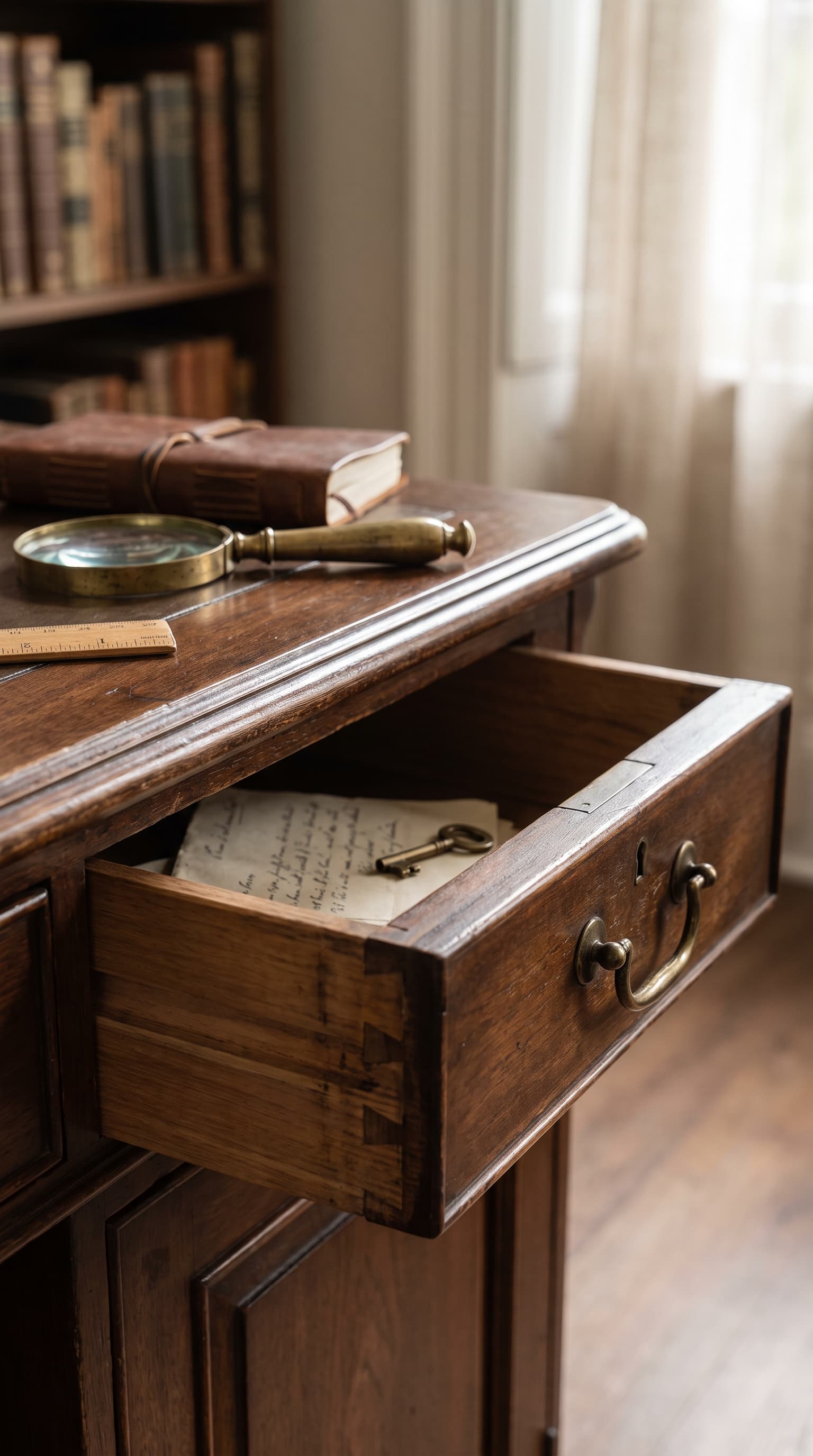
Antique Desk Identification: How to Identify Desk Styles and Hardware
Antique desk identification starts with understanding the relationship between form, hardware, and construction. A desk's silhouette—whether it's a slant-front secretary, a roll-top, or a partners desk—can narrow the date range by decades. But the real clues lie in the joinery, the drawer pulls, the wood grain, and the tiny quirks that separate a Colonial-era piece from a 1920s reproduction.
Most people focus on surface beauty and miss the structural details that tell the true story. Learning to spot dovetails, recognize period-correct hardware, and distinguish hand-planed surfaces from machine work transforms guesswork into confident identification.
What Clues Matter in Antique Desk Identification
Desk Form and Silhouette
The overall shape reveals both the era and the original use. A slant-front desk with a fall-front writing surface and interior cubbyholes typically dates from the 18th or early 19th century. Roll-top desks—with their tambour or slatted covers—gained popularity in the 1870s through the early 1900s, especially in offices. Partners desks, large enough for two people to sit facing each other, became common in Victorian-era libraries and law offices.
Look at the proportions. Georgian and Federal desks tend to be taller and more vertical. Victorian desks sprawl wider, with heavier moldings and more ornamentation. Art Deco desks from the 1920s and 1930s favor streamlined forms, often with geometric inlays or chrome accents.
Joinery and Construction Methods
How the desk is put together is one of the most reliable dating tools. Hand-cut dovetails—irregular, slightly uneven, and wide-spaced—point to pre-1860 construction. Machine-cut dovetails, which became standard after the 1870s, are uniform and evenly spaced. Drawer bottoms on older desks typically run front-to-back and sit in grooves; later pieces often use plywood or run side-to-side.
Check how the desk is assembled. Early desks use mortise-and-tenon joints secured with wooden pegs. If you see screws, note the type: hand-filed screws with off-center slots and irregular threads predate the 1840s. Later machine-made screws have centered slots and uniform threads.
Hardware and Pulls
Drawer pulls and escutcheons change with fashion. Brass bail pulls with cotter-pin attachments are common on 18th-century desks. Stamped-brass pulls with threaded posts suggest the Victorian era. Wooden knobs were popular in the 1820s–1840s, especially on American Empire and Biedermeier-inspired pieces.
Examine the keyholes and locks. Hand-filed locks with visible file marks indicate earlier work. If the hardware looks too shiny or perfectly uniform, it may be a replacement or a reproduction.
Wood Species and Finish
The type of wood can point to both region and period. Walnut was favored in the 18th century, especially in England and America. Mahogany dominated from the late 1700s through the Victorian era. Oak resurged in the Arts and Crafts movement of the early 1900s. Exotic veneers like satinwood, rosewood, and zebrawood appear on high-style Federal and Regency desks.
Look at the finish. Shellac was the standard finish through the 19th century and develops a warm, slightly orange patina. Lacquer and polyurethane are 20th-century products. A desk with a thick, plastic-like finish is likely mid-century or later.
What Photos to Take for Antique Desk Identification
Good photos make all the difference when identifying a desk remotely. Start with the overall form: shoot the desk straight-on from the front, then from each side and the back. These angles capture proportions and reveal any asymmetry or unusual features.
Zoom in on the hardware. Photograph each pull, lock, and hinge from close range, ideally with enough detail to see wear, patina, and attachment methods. If the hardware has been replaced, that's important information.
Open the drawers and photograph the joinery. Show the dovetails at the corners, the drawer bottom construction, and any markings or labels inside. If there's a signature, maker's mark, or penciled date, capture it clearly.
Photograph the underside and back. These hidden areas often retain original surfaces and show construction techniques that were never meant to be seen. Look for saw marks, plane marks, or hand-tool textures.
If the desk has a writing surface or interior compartments, photograph those too. The layout, the presence of secret drawers, and the quality of small details all contribute to identification.
Common Misidentifications in Antique Desks
Confusing Reproduction with Period
Colonial Revival desks from the 1920s and 1930s mimic 18th-century forms but use machine joinery, thinner wood, and modern finishes. A slant-front desk isn't automatically Georgian just because it looks the part. Check the construction details—machine dovetails, plywood drawer bottoms, and stamped brass pulls are giveaways.
Mistaking Refinished for Original Finish
Many antique desks have been stripped and refinished, sometimes multiple times. A desk that's been heavily sanded loses patina, tool marks, and evidence of age. What looks "old" to the untrained eye might simply be dark stain applied to mimic age. Original finishes show uneven wear in logical places: around pulls, along edges, where hands rest.
Overvaluing Altered or Married Pieces
Some desks combine parts from different pieces or different eras. A desk base might be period, but the top or gallery could be a later addition. Married pieces can still have value, but they're not the same as an untouched original. Look for mismatched wood grain, inconsistent joinery, or hardware that doesn't align with screw holes.
Assuming All Oak Desks Are Mission or Arts and Crafts
Oak enjoyed multiple waves of popularity. Golden oak desks from the 1890s–1920s are common and were mass-produced. They're often confused with handcrafted Mission or Arts and Crafts pieces, which feature exposed joinery, hand-hammered hardware, and a heavier, more architectural feel. A plain oak roll-top from a catalog is not the same as a Stickley desk.
What Tocuro Can Help Resolve
When you're staring at a desk and still unsure of its age, maker, or style, a second set of eyes—especially one trained on thousands of examples—makes a difference. Tocuro uses photo-based identification to help you understand what you're looking at. Upload clear images of the desk's form, hardware, joinery, and any marks, and Tocuro provides context: likely period, style, and estimated value range based on current market signals.
Tocuro handles more than just desks. If you're working through an estate or a collection, you can identify vintage jewelry, china patterns, cut glass, and more—all from photos. You get 7 free identifications per day, and that count resets daily, so you can work through a houseful of items at your own pace.
The value estimates are not formal appraisals, but they give you a realistic sense of what similar pieces are bringing at auction, online, and in the secondary market. That's useful whether you're buying, selling, insuring, or simply curious.
Ready to Identify Your Desk?
If you've got a desk and want to know more—whether it's the style, the maker, the era, or the value—start with good photos. Capture the form, the joinery, the hardware, and any hidden marks. Then let Tocuro help you put the pieces together. You'll get clarity, context, and a clearer sense of what you own.
Photo identification
Identify Your Furniture
Use Tocuro to identify your item from a photo and get an estimated value range when market data is available.