
How to Identify Antique Chest of Drawers: A Guide to Dating from Photos
Master the art of antique chest of drawers identification by examining dovetail joints, secondary wood, drawer runners, and hardware. This guide shows you which details matter most and what photos reveal the true age of case furniture.
How to Identify Antique Chest of Drawers: A Guide to Dating from Photos
That tall dresser in your grandmother's bedroom or the small chest you spotted at an estate sale might be genuinely old—or a convincing reproduction. Antique chest of drawers identification hinges on understanding construction details that changed dramatically over three centuries. The good news? Most of these clues show up clearly in the right photos, even if you can't visit the piece in person.
What Clues Matter Most for Antique Chest of Drawers Identification
Chests of drawers reveal their age through details that evolved as cabinetmaking technology changed. Focus on these areas first.
Dovetail Joints
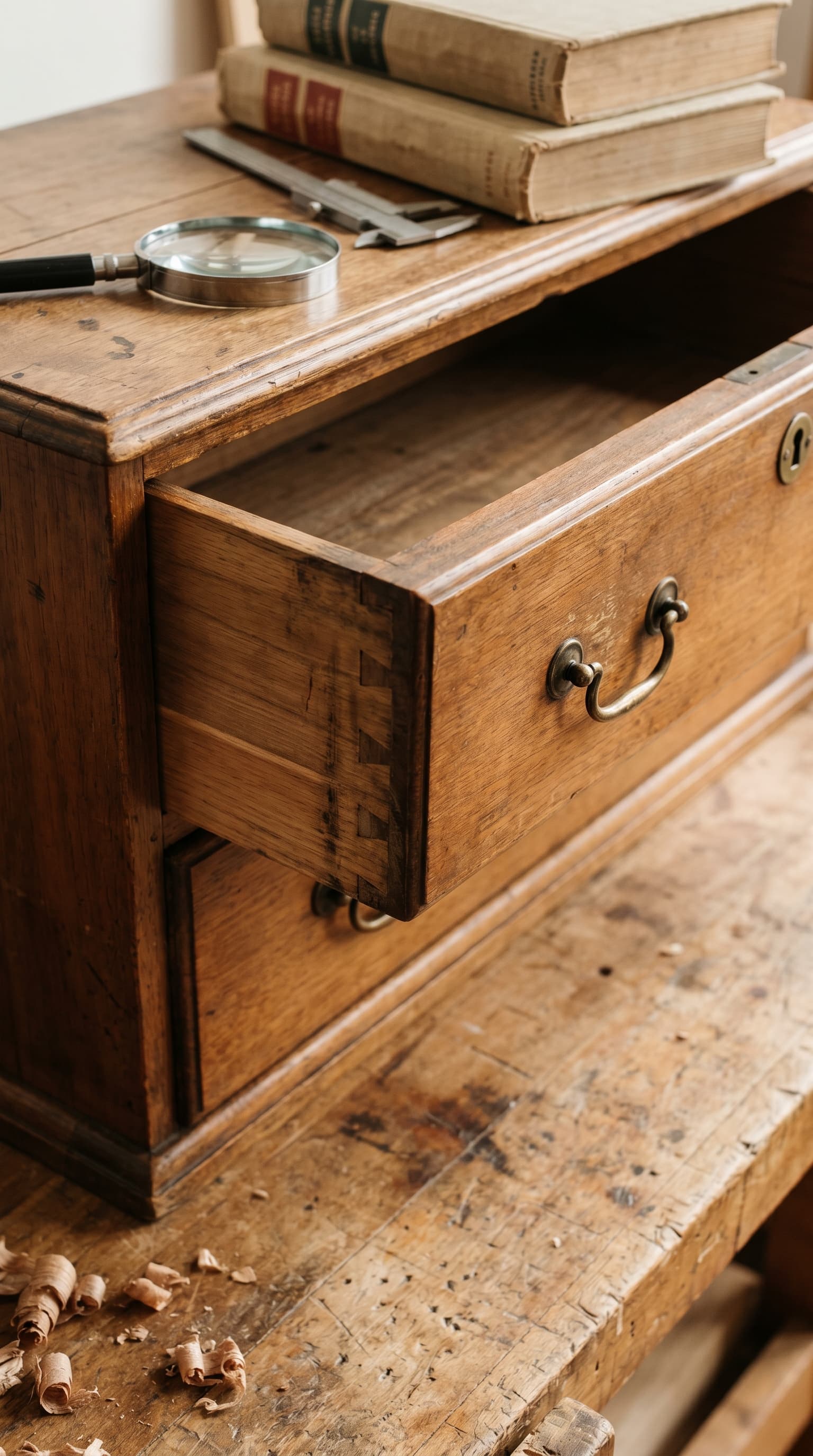
The joints connecting drawer fronts to sides tell the clearest story. Hand-cut dovetails before 1860 show irregular spacing, varying sizes, and pins that don't quite match perfectly. They're beautiful in their imperfection. Early machine-cut dovetails from 1860-1890 appear more uniform but still show some variation. By 1900, machine dovetails became perfectly regular with identical spacing. Modern reproductions often use even simpler joints or hide machine dovetails under veneer.
Pull a drawer completely out and flip it over. Look at how the front, back, and sides connect. Count the dovetails—hand-cut pieces typically have fewer, larger dovetails than machine-cut versions.
Secondary Wood Species
Antique furniture makers used expensive primary woods like mahogany or walnut only where visible. Hidden structural parts—drawer sides, backs, bottoms, and interior frames—got cheaper secondary woods. These choices reveal both age and origin.
American pieces commonly used pine, poplar, or oak for secondary wood. English furniture often features oak or pine secondaries. The combination matters: a mahogany chest with poplar drawer sides likely came from America, while oak secondaries suggest English origin. Modern reproductions sometimes use plywood or particle board in hidden areas, an immediate red flag.
Drawer Runner Systems
How drawers slide in and out changed over time. The oldest chests (pre-1750) often have drawer bottoms that run directly on the case frame—no separate runners at all. By the late 1700s, side-hung drawers with runners attached to the case became standard. Victorian pieces introduced center guides and various patented sliding mechanisms.
Look underneath and inside the case. Are there grooves worn into wooden runners? That wear pattern develops over decades of use and can't be easily faked.
Hardware and Mounts
Original hardware provides strong dating evidence, though many pieces have had pulls replaced over the years. Brass bail pulls dominated 1700s American furniture. Wooden knobs became popular in the early 1800s. Glass knobs appeared after 1820. Victorian pieces often featured ornate cast brass or pressed metal pulls.
Flip handles and examine mounting holes from inside the drawer. Multiple sets of filled holes indicate replacement hardware—not necessarily bad, but worth noting. Modern machine screws suggest recent replacements.
Surface and Finish
Antique wood develops patina that deepens where hands touched frequently and lightens on horizontal surfaces exposed to light. The finish itself matters too. Shellac dominated until the 1920s. Lacquer came later. Polyurethane is distinctly modern.
Photograph the top surface in angled light to reveal finish texture. Original shellac shows a thin, slightly uneven application. Modern reproductions often have thick, perfectly smooth polyurethane.
What Photos to Take for Accurate Identification
The right images make antique chest of drawers identification possible from a distance. Capture these specific views:
Overall shots from the front and both sides establish form and proportion. Include the entire piece with a few feet of surrounding space for scale.
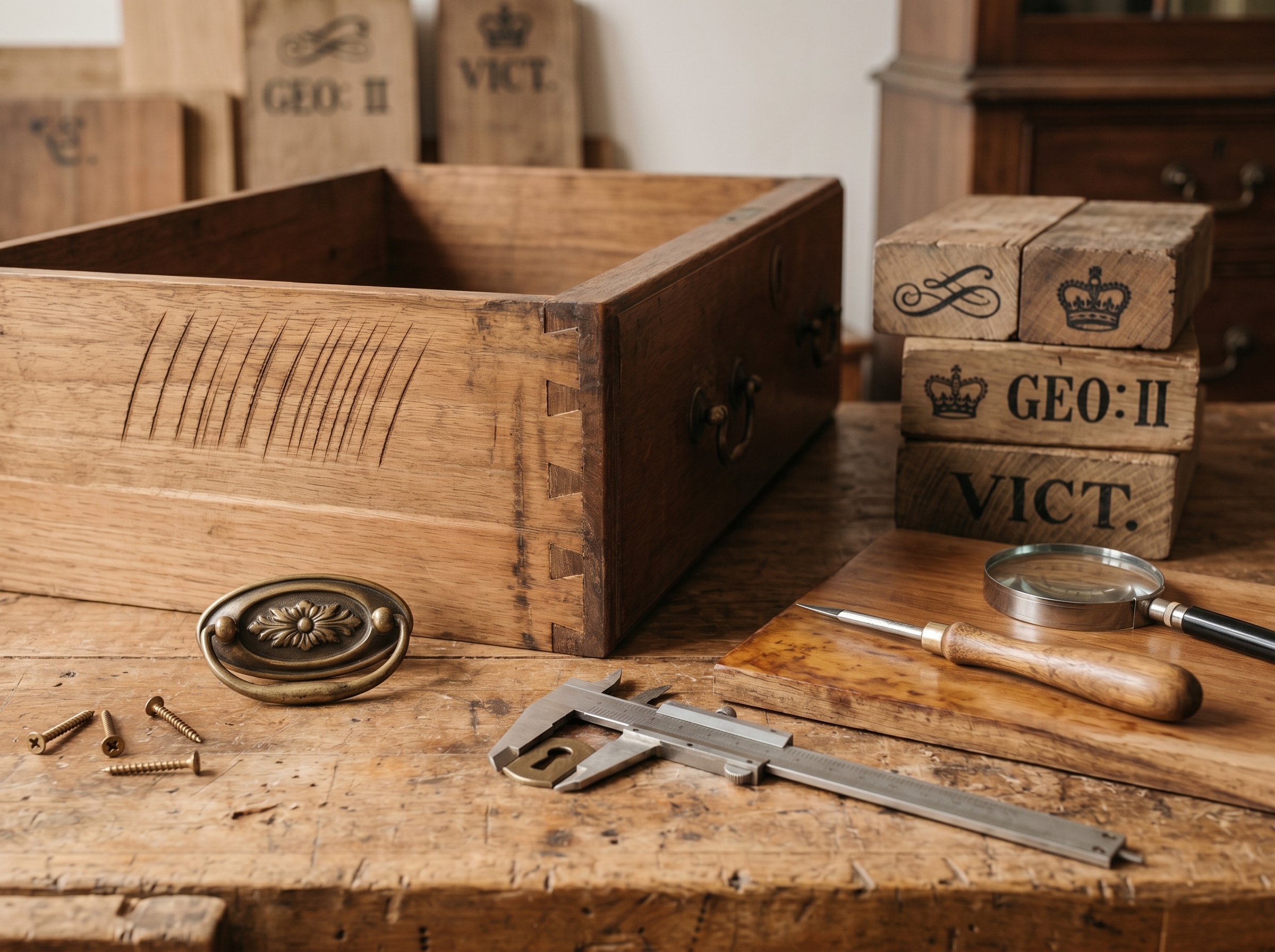
Drawer construction close-ups are essential. Pull out the top and bottom drawers. Photograph dovetail joints from multiple angles. Flip drawers over to show the underside construction and any maker's marks or stamps.
Secondary wood details require well-lit shots of drawer sides, backs, and bottoms. The wood grain should be clearly visible. Include shots of the case interior where the primary wood transitions to secondary species.
Hardware details need close-ups showing mounting style, patina, and any maker's marks on the metal itself. Photograph the back of one pull and the mounting area inside a drawer.
Wear patterns tell age stories. Photograph worn drawer runners, scuffed feet, scratches on drawer edges where they've caught over decades. Include worn spots on drawer fronts where hands pulled.
Back panel construction reveals manufacturing methods. Old chests have individual boards sometimes with rose-head nails or irregular spacing. Photo the entire back if accessible.
The more specific detail photos you provide, the more confident any identification can be. Broad room shots rarely show the construction clues that matter.
Common Misidentifications
Certain assumptions trip up collectors repeatedly when trying to identify antique chests of drawers.
"Dark Wood Means Old"
Stain creates the same dark tones on new pine that age produces on walnut. Many 1920s-1980s Colonial Revival reproductions used stained maple or birch to imitate mahogany. Look past color to construction details.
"Ornate Equals Valuable Victorian"
Elaborate applied carving and fancy veneer flourished during the Victorian era, but mass production techniques made ornate furniture affordable and common. Highly decorated pieces aren't automatically rare or valuable. Construction quality matters more than surface decoration.
Confusing Campaign Chests with Age
Brass-bound "campaign" style chests became popular reproductions in the 1960s-1980s. Genuine British campaign furniture from the 1800s shows specific joinery and hardware styles. Modern versions often use recessed hardware that looks military but wasn't period-accurate.
Assuming Machine Dovetails Mean Fake
Machine-cut dovetails appeared in the 1860s. A chest with uniform dovetails isn't necessarily a reproduction—it might be genuinely old but not quite as old as hand-dovetailed pieces. Context matters.
What Tocuro Can Help Resolve
Identifying antique furniture involves weighing multiple construction clues, understanding regional variations, and recognizing how styles evolved across decades. Even experienced collectors benefit from a second opinion when details seem contradictory.
Tocuro analyzes photos of your chest of drawers to identify construction period, likely origin, and style classification based on the specific details visible in your images. The platform recognizes dovetail patterns, wood species, hardware styles, and finish characteristics that indicate age.
Upload clear photos showing the areas detailed above—dovetail joints, secondary wood, drawer construction, hardware, and wear patterns. You'll receive an estimated age range and style identification drawn from market signals and construction databases. This estimated information helps you research further and understand what you own, though it's not a formal appraisal.
When you're uncertain whether that tall chest is a genuine 1840s Empire piece or a 1940s reproduction, the right photos can often resolve the question. Similar identification approaches work for other furniture types as well.
Making Confident Identifications
Antique chest of drawers identification rewards careful observation. The drawers themselves contain the most reliable evidence—pull them out, flip them over, photograph the joinery. Secondary wood species, hardware mounting, and runner systems provide additional confirmation.
No single detail proves age definitively. A piece might have old dovetails but replaced hardware. Another might show genuine wear but suspicious finish. Weigh all the evidence together. When details align—hand-cut dovetails, appropriate secondary wood, period hardware, genuine wear, and correct proportions for the supposed era—you can identify with confidence.
For pieces with mixed signals or when you need a clearer answer, photograph the key construction details and get an identification based on those specific visual clues. Understanding what you own makes better collecting decisions possible.
Photo identification
Identify Your Furniture
Use Tocuro to identify your item from a photo and get an estimated value range when market data is available.