
Pottery Marks Identification: How to Find, Read, and Photograph Marks
Pottery marks can reveal maker, period, and origin—but only if you know where to look and how to read them. This guide shows you where marks hide, what they can and cannot tell you, common identification pitfalls, and why good photos matter when researching your pottery.
Pottery Marks Identification: How to Find, Read, and Photograph Marks
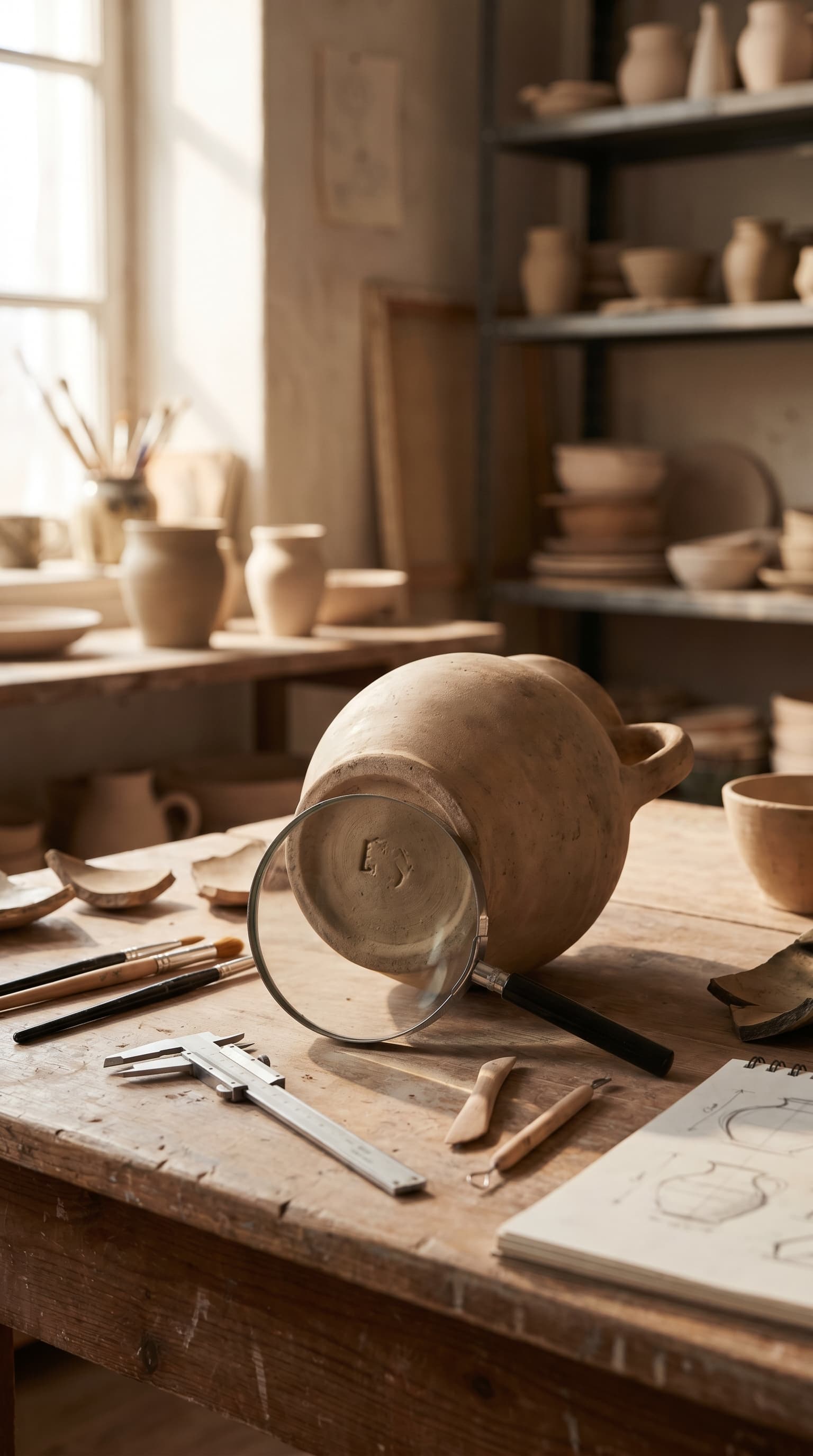
Pottery marks identification starts with knowing where to look. A mark on the base of a vase or dish can reveal the maker, approximate date, and country of origin—but pottery marks are easy to misread, and not every piece has one. Whether you're sorting through an estate, evaluating a thrift store find, or cataloging your own collection, understanding what marks can and cannot tell you saves time and helps you avoid costly mistakes.
Where to Find Pottery Marks
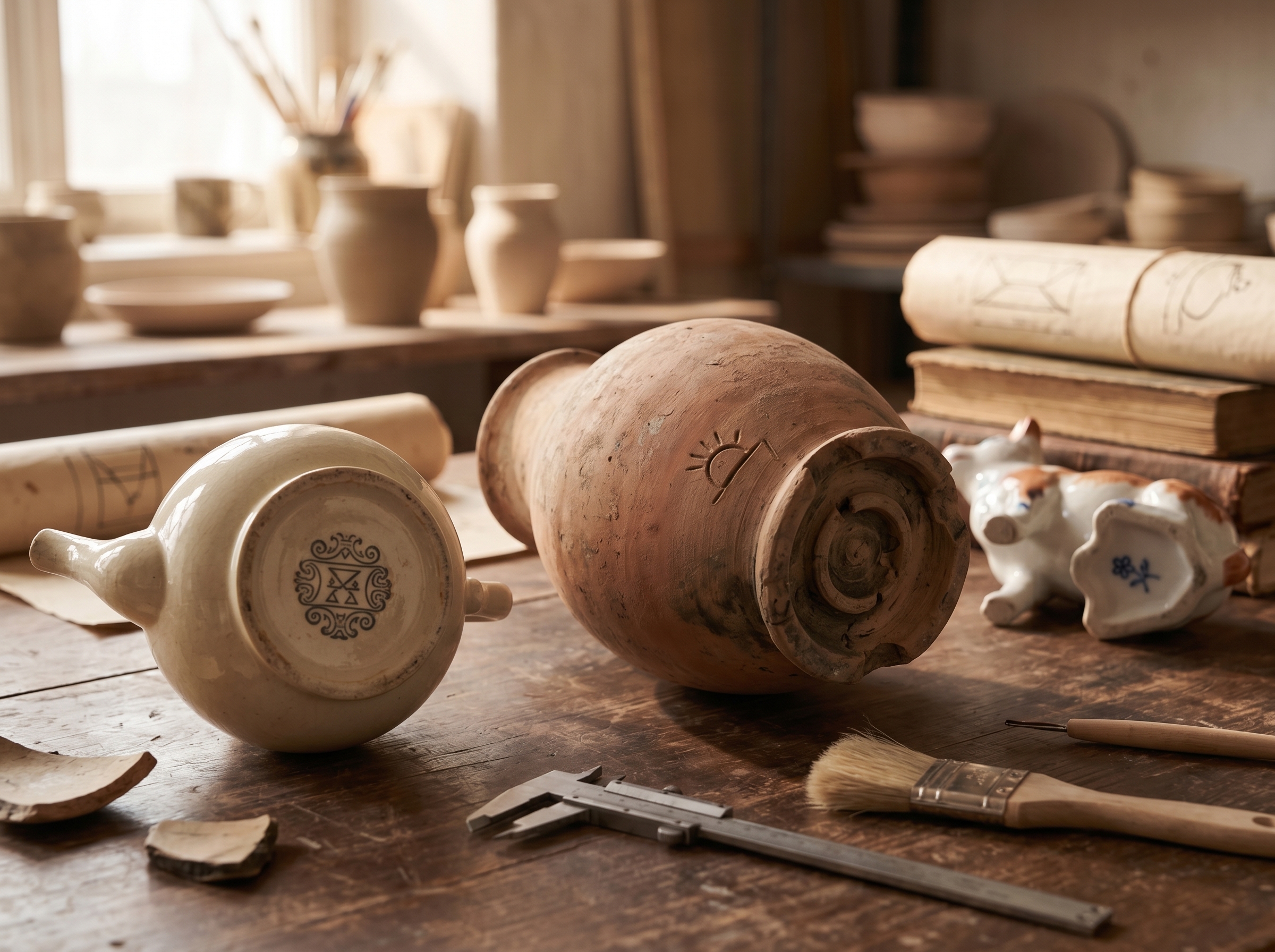
Most pottery marks appear on the base or underside of a piece, but makers didn't follow universal rules. Here's where to check:
Base or bottom: The most common location. Turn plates, bowls, vases, and figurines upside down. Marks may be impressed (stamped into wet clay), incised (scratched in), painted, or printed with ink or transfer.
Inside the rim or foot ring: Some makers placed small marks inside the foot ring (the raised circle on the base) or just inside the rim of bowls and cups. These can be faint or partially obscured by glaze.
Back or reverse side: Wall pockets, plaques, and tiles often carry marks on the back surface. Figurines sometimes have marks molded into the back or base.
Hidden under handles or lids: Teapots, tureens, and covered dishes occasionally have marks under the handle attachment or inside the lid. Check both the lid and the base separately.
Paper labels: Mid-century and later pottery often used paper stickers instead of permanent marks. These labels fall off or fade, leaving no visible mark at all. If you see adhesive residue, a label was likely there.
Some high-quality art pottery and studio pieces are unmarked entirely. Absence of a mark doesn't mean your piece is worthless—it just means identification relies on form, glaze, and style instead.
What Pottery Marks Can and Cannot Tell You
Marks provide clues, not complete stories. Here's what you can reasonably expect:
What marks often reveal
- •Maker or manufacturer name: Many marks include the pottery's name or logo, sometimes abbreviated or stylized.
- •Country of origin: "England," "Made in Japan," or "Germany" stamped on the base indicates where the piece was made and can help narrow the date range.
- •Approximate date range: Marks changed over time. A specific logo or stamp style can often be dated to within a decade or two using reference guides.
- •Pattern or line name: Some marks include pattern names or numbers, especially on dinnerware and decorative sets.
What marks cannot tell you
- •Exact production date: Marks indicate a range, not a specific year. A mark used from 1920 to 1935 doesn't tell you whether your piece is from 1921 or 1933.
- •Guaranteed authenticity: Marks can be forged, copied, or applied to reproductions. A mark alone doesn't prove a piece is genuine.
- •Condition or rarity: The mark tells you who made it, not whether your piece is common, rare, or in good enough condition to command high prices.
- •Retail value: Two pieces with identical marks can have vastly different values depending on form, decoration, size, condition, and current collector demand.
Marks are a starting point. Combine them with details about glaze, shape, decoration, and overall quality to build a complete picture.
Common Pottery Marks Misreads
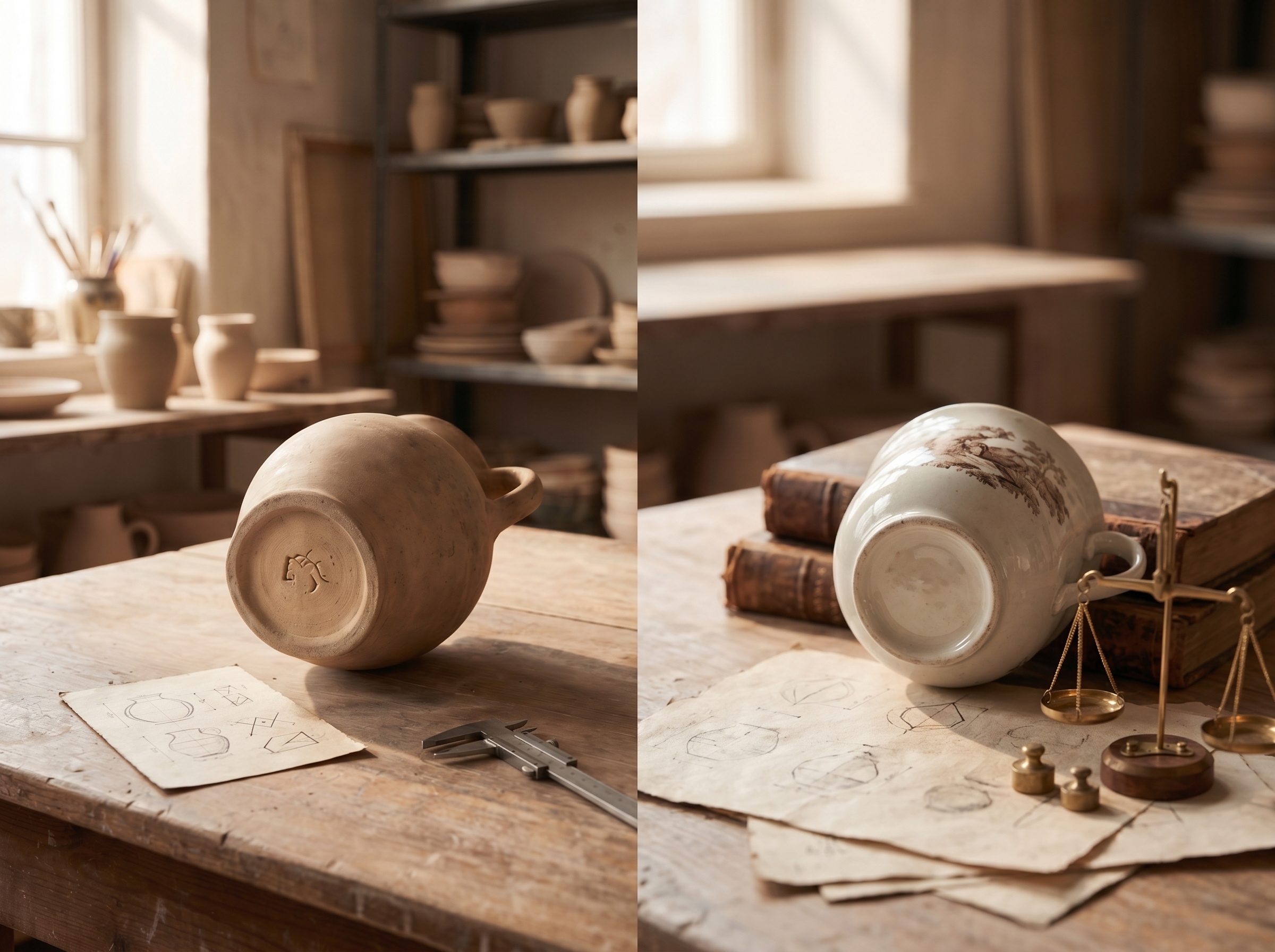
Pottery marks are often small, worn, smudged, or stylized in ways that make them hard to decipher. Here are frequent mistakes:
Confusing logos with letters: Makers used monograms, symbols, and abstract shapes. What looks like a "W" might be a stylized double-V or a maker's symbol. Always compare the mark to verified examples before assuming you've read it correctly.
Misidentifying country marks: "Foreign" stamped on a piece doesn't name the country—it means the item was imported to the U.S. before 1914. "Occupied Japan" dates a piece to 1945–1952, but doesn't identify the specific maker.
Assuming hand-painted marks are older: Hand-painted marks can appear on recent pottery. Conversely, transfer-printed marks (applied like decals) date back to the 18th century. The method of marking doesn't reliably indicate age.
Reading impressed marks backward: Impressed marks stamped into wet clay sometimes transfer in reverse or appear incomplete. Compare the mark to known examples in both orientations.
Overlooking partial marks: Glaze runs, grinding during production, and wear can obscure parts of a mark. A partial circle with a few visible letters might still be identifiable if you know what to look for.
Trusting reproductions: Modern reproductions sometimes carry fake or misleading marks that mimic historic makers. Cross-check the mark against the piece's weight, glaze quality, clay body, and construction. If something feels off, the mark alone shouldn't settle the question.
How Photos of Pottery Marks Improve Results
A clear photo of a pottery mark is often more useful than a verbal description. Here's how to capture marks effectively:
Lighting angle: Use indirect natural light or a lamp positioned at a low angle to the surface. Side lighting reveals impressed and incised marks by casting shadows in the grooves. Overhead light flattens detail and makes faint marks disappear.
Focus and resolution: Fill the frame with the mark itself. Blurry photos or shots taken from too far away lose the fine details—letter serifs, small symbols, or partial impressions—that distinguish one maker from another.
Multiple angles: If the mark is inside a foot ring, curved, or partially obscured by glaze, take several shots from different angles. One may capture details the others miss.
Context shots: Include a photo of the entire piece alongside the mark photo. Form, size, glaze, and decoration help confirm whether a mark matches the known output of a given maker.
Clean the surface gently: Dirt and glaze buildup can hide marks. Wipe the base with a damp cloth—avoid abrasives or harsh chemicals that might damage the surface.
When you're ready to identify your pottery, upload photos of both the mark and the full piece in Tocuro. The app uses those images to suggest makers, date ranges, and comparable items based on market signals. You get 7 free identifications per day, and the count resets daily, so you can work through a collection at your own pace. Estimated values are based on current market data, not formal appraisals, giving you a practical starting point for research or selling decisions.
Reading Initials and Artist Signatures on Pottery Marks
Studio pottery and art pottery often carry hand-painted or incised initials instead of factory stamps. These marks identify individual artists or small workshops. A looping "RP" might be Russel Wright, while a blocky "JB" could be dozens of different potters.
Initials alone rarely provide enough information without other clues—glaze technique, clay body color, form style. Cross-referencing the mark with the piece's aesthetic and regional origin helps narrow possibilities. Some artists used consistent signature styles across decades; others experimented.
If the initials appear with a location—"Taos," "Seagrove," "Cornwall"—that's a strong regional clue. American studio pottery from the mid-20th century often includes town names or state abbreviations.
Country of Origin Marks and What They Mean
Country marks follow legal requirements that shifted over time. Understanding these rules helps date pottery even when the maker is unknown.
- •"England" alone: 1891–1921 (McKinley Tariff Act required country labels)
- •"Made in England": 1921 onward
- •"Occupied Japan": 1947–1952 (items made during Allied occupation)
- •"West Germany": 1949–1990 (divided Germany era)
- •"Czechoslovakia": 1918–1993 (before Czech Republic and Slovakia split)
These labels offer date brackets but don't pinpoint exact years. A "Made in Japan" mark could span 1921 to the present unless other stylistic details narrow it further.
Why Pottery Marks Matter—and When They Don't
Marks help sort pottery by maker and era, which speeds up research and helps you spot potentially valuable pieces. But not every collectible pottery item has a mark, and not every mark guarantees value. Art pottery from recognized studio artists, limited production runs, and pieces with exceptional decoration or form can command strong prices even without marks. Conversely, mass-produced pottery with clear marks may be common and affordable.
If you're evaluating pottery for a sale, insurance, or collection, start with the mark but don't stop there. Look at glaze quality, hand-painted details, mold seams, weight, and overall craftsmanship. Compare your piece to documented examples. And when you need a faster answer, good photos of the mark and the piece together give identification tools the information they need to help.
For more on how photos help with authenticity questions across categories, see How to Tell If Furniture Is Authentic: What Photos Reveal About Reproductions. If you're curious how identification works for marks in other materials, check out Silver Hallmarks Identification: How to Read and Photograph Marks That Matter.
Pottery marks identification works best when you combine close observation, reference checking, and clear photography. The mark is a clue, not a conclusion—but it's often the best clue you have.
Photo identification
Identify a Pottery Mark
Use Tocuro to identify your item from a photo and get an estimated value range when market data is available.